Tag: research

  • STUDY: Low-income students in households making less than $28K annually now a majority in the nation’s public schools

    STUDY: Low-income students in households making less than $28K annually now a majority in the nation’s public schools

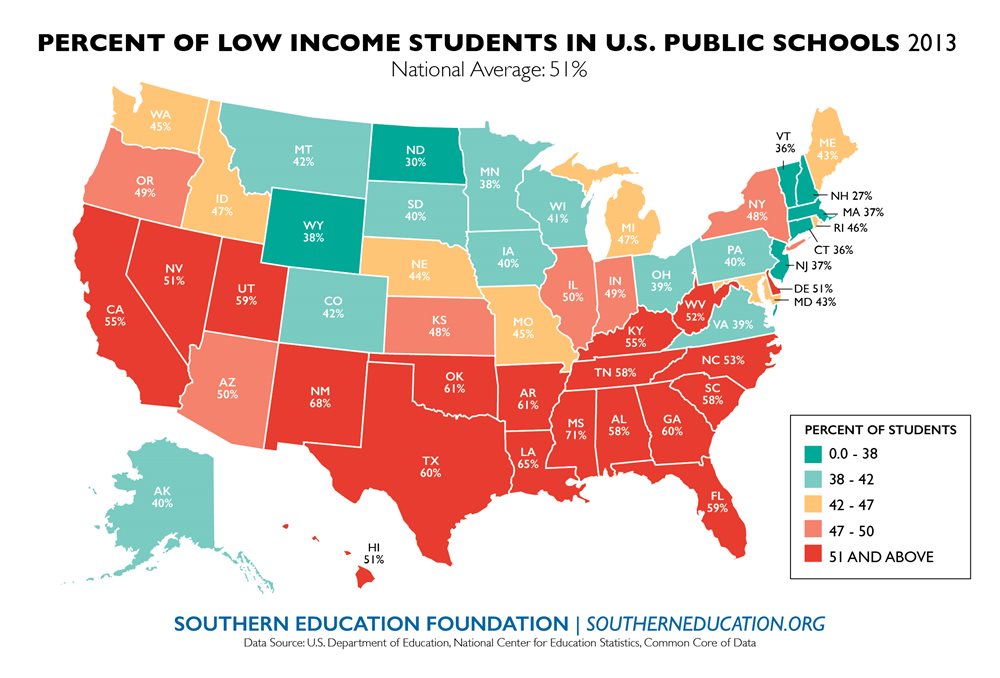
    Low-income students — those living in a single-parent household earning less than $28,000 a year — are now a majority of the schoolchildren attending the nation’s public schools, according to new analysis of state data compiled and analyzed in a January, 2015, report from the Southern Education Research Foundation.  The January, 2015,  report is based on data available from the federal government’s National Center for Education Statistics (NCES). It shows that, as of 2013, 51 percent of the students across the nation’s public schools were low income in 2013.

    “In 40 of the 50 states, low-income students comprised no less than 40 percent of all public schoolchildren. In 21 states, children eligible for free or reduced-price lunches were a majority of the students in 2013,” says a report on the NCES-collected data in the study written by the Southern Education Foundation. 

    A Washington Post article written by Lindsey Layton covered the Southern Education Research Foundation report. Layton wrote: “The shift to a majority-poor student population means that in public schools, a growing number of children start kindergarten already trailing their more privileged peers and rarely, if ever, catch up. They are less likely to have support at home, are less frequently exposed to enriching activities outside of school, and are more likely to drop out and never attend college.”

    Education is portrayed as the most effective weapon in the fight against inequality. The article quotes Darren Walker, the president of the Ford Foundation voicing his concern:

    “Even at 8 or 9 years old, I knew that America wanted me to succeed,” he said. “What we know is that the mobility escalator has simply stopped for some Americans. I was able to ride that mobility escalator in part because there were so many people, and parts of our society, cheering me on . . . we need to fix the escalator. We fix it by recommitting ourselves to the idea of public education. We have the capacity. The question is, do we have the will?”

    What is low income? The SERF report used eligibility for free or reduced lunch to define low income.  The researchers wrote that: “Students are eligible for free meals at public schools if they live in households where the income is no more than 135 percent of the poverty threshold. They are eligible for reduced-price lunches if their household income is no more than 185 percent. In 2013, for example, a student in a household with a single parent with an annual income of less than $19,669 was eligible for a free lunch or less than $27,991 for a reduced-price meal in a public school.”

  • GMU assisting project on ideas to change the playing field for corporations, people and democracy

    ARLINGTON, Va. – A multi-partisan spectrum of business, policy and public groups is seeking common ground on changes to the U.S. economic system affecting the regulation and governance of corporations, their impact on consumers, markets, communities and the planet.

    The “Rules Change Project” — at http://www.ruleschange.org — is seeking input from executives, public officials, scholars, researchers, policy activists, students and engaged citizens.

    “It’s time to cross lines, exit silos and listen,” says Bill Densmore, an ex-journalist and researcher who is one of the project organizers. “We want to look at how government and business can collaborate to meet the needs of all stakeholders – employees, customers, citizens, communities and the environment – not just stockholders.” The project aims to bring together silos of thought in a reflective, collaborative, national timeout for corporations, citizens and democracy. It’s designed to assess two decades of mainstream thought on corporate regulation, governance and global-resources impact.

    “Rules Change” is a pioneering national attempt to convene diverse groups working on topics like corporate personhood, money and politics, measurement, accountability and governance that will rethink the game in the public interest, organizers say.

    The project is being assisted by the School of Public Policy at George Mason University and the Media Stewards Project, with advice from the Aspen Institute’s Business & Society Program, the New Economics Coalition (NEI) and the F.B. Heron Foundation..

    “Whether they are worried about the power of government, the power of corporations or diminished public participation in civic affairs, millions of Americans are starting to think the rules of the game need to be reinforced or changed,” says Mark J. Rozell, acting dean of George Mason University’s School of Public Policy.

    Rules Change aims to promote cross-silo knowledge, ideas and collaboration on issues like election reform, corporate personhood, success measures and accountability, money and politics, media responsibility and environmental sustainability. Attendees will look at the rules that govern our economic system – from laws and regulations to consumer behavior, participatory government, corporate governance and more.

    “The idea is to pause and collaboratively and consider feasible changes in the rules of the game that promote the public interest,” says John Boyer, a former professor and TV documentary producer who is among organizers of the gathering. “How are we going to get America working better for all of us?”

    One effort championed by the Rules Change Project is The Civic Stewardship Mapping Project, a multimedia effort to document for the public dozens of groups working on rules-change initiatives. “It will be a navigational tool for concerned citizens to find out where and how they can do something,” says Marcy Murninghan, mapping-project coordinator.

    Rules Change is organized around five “rules-change categories” highlighting policy agendas of diverse groups that share the goal of a more just and sustainability society, says Densmore, Rules Change Project coordinator. “Those categories include influence, measurement, ownership, accountability and governance,” says Densmore. “We want to create a time-out space for partisans across the playing field to find common ground on rules — rather than face ongoing gridlock and perceived unfairness in the game.”

    The Rules Change Project seeks input from individuals and groups working on topics such as:

    • Non-partisan redistricting
    • Changes in a “too-big-to-fail” banking system
    • Corporate governance and sustainability
    • Alternate success indicators besides GNP
    • Reducing or revealing the influence of money on Washington
    • Economic policies to rebuild a middle class

    The rules of American capitalism have evolved from a shared circle of prosperity,” says John Boyer, an event co-organizer and co-founder of the Media Stewards Project. “Business and government leaders once saw four key stakeholders — communities, employees, the environment and customers — as team members along with stockholders. That’s less and less true. America’s economy cannot fairly go on the way it has. It’s time to see if rules change – policy, marketplace, social, ethical — can restore balance among all five stakeholders.”

    ADDITIONAL RESOURCES:

    For additional information contact:

    Bill Densmore, (617-448-6600) / wpdensmore@gmail.com or John Boyer, Co-Founder, Media Stewards Project (703-980-3337) / john@mediastewards.org