Category: Equity

  • The Burden of Student Loans

    The Burden of Student Loans

    The problem of growing student-loan debt has surfaced as one of the major issues facing our country, because they are creating a class of Americans — some of them now elderly — who are burdened from young adulthood with debt and therefore forced to make career decisions with that in mind.

    Student loans (BACKGROUND) offer both young Americans and parents an avenue through which they can afford the rising costs of colleges and universities. A college degree, however, no longer ensures employment for young graduates who consequentially find it more difficult to keep up with their payments. For the first time in history, U.S. student-loan debt is over $1 trillion. The federal government is seeing an increased number of delayed payments on loans.[1]

    SOURCES: www.kansascityfed.org/publicat/reswkpap/pdf/rwp%2012-05.pdf?wf=rs082712; Federal Reserve Bank of New York Consumer Credit Panel and Equifax.
    SOURCES: www.kansascityfed.org/publicat/reswkpap/pdf/rwp%2012-05.pdf?wf=rs082712; Federal Reserve Bank of New York Consumer Credit Panel and Equifax.

    Student loan policy is an example of how bureaucratic interest can drive real policy. An article published in 2003 by the U.S. News and World Report took a behind-the-scenes look at the political lobbyists who were pushing the burden of student loans on American taxpayers in return for big profits from Federal Family Education Loans (FFEL) loans. From 2000 to 2003 lobbyists had convinced over 62 colleges to drop out of the direct loans program.[2] The larger private organizations that serviced student loans, such as Sallie Mae, used profits to increase their presence in Washington, particularly with Republicans. It is reported that Sallie Mae has spent close to $6 million on political contributions from 1992 to 2012.[3]

    With the Democrats in control of Congress, Obama signed the Affordable Care Act that effectively ended the guaranteed loans program by eliminating any FFEL loans after July 1, 2010.[4] The decision to end the FFEL program is estimated to save $68.7 billion over the next 10 years.[5]

    While 2010 represented a major change in the student loan policy, the problem of a huge and growing debt still exists. Students from the class of 2014 graduated school with an average debt of $26,600 a person.[6] There are also an estimated two million Americans age 60 and older that are still in debt from student loans, and the size of that debt has grown from eight to $43 billion between 2005-2014.[7], especially from for-profit schools. The rules change that eliminated guaranteed loans certainly was the most significant student loan policy change to date. However, there is still clearly much remaining policy work to be done in order to realize President Obama’s hope that, “People who have the grades, the desire and the will, but not the money, can still get the best education possible.”

    RELATED LINKS:

    FOOTNOTES:

  • STUDY: Low-income students in households making less than $28K annually now a majority in the nation’s public schools

    STUDY: Low-income students in households making less than $28K annually now a majority in the nation’s public schools

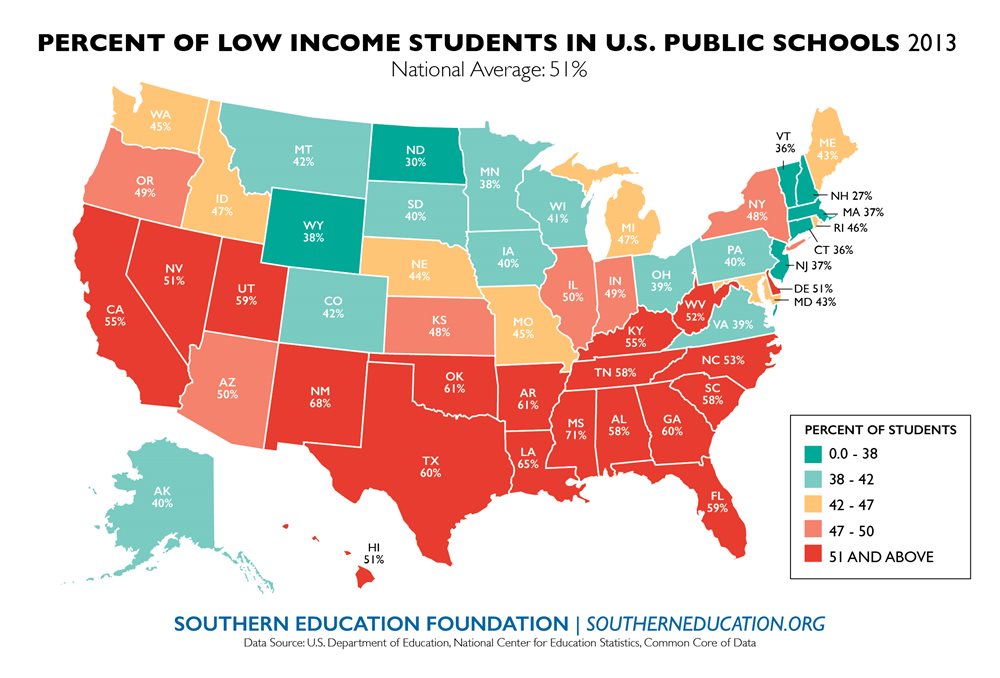
    Low-income students — those living in a single-parent household earning less than $28,000 a year — are now a majority of the schoolchildren attending the nation’s public schools, according to new analysis of state data compiled and analyzed in a January, 2015, report from the Southern Education Research Foundation.  The January, 2015,  report is based on data available from the federal government’s National Center for Education Statistics (NCES). It shows that, as of 2013, 51 percent of the students across the nation’s public schools were low income in 2013.

    “In 40 of the 50 states, low-income students comprised no less than 40 percent of all public schoolchildren. In 21 states, children eligible for free or reduced-price lunches were a majority of the students in 2013,” says a report on the NCES-collected data in the study written by the Southern Education Foundation. 

    A Washington Post article written by Lindsey Layton covered the Southern Education Research Foundation report. Layton wrote: “The shift to a majority-poor student population means that in public schools, a growing number of children start kindergarten already trailing their more privileged peers and rarely, if ever, catch up. They are less likely to have support at home, are less frequently exposed to enriching activities outside of school, and are more likely to drop out and never attend college.”

    Education is portrayed as the most effective weapon in the fight against inequality. The article quotes Darren Walker, the president of the Ford Foundation voicing his concern:

    “Even at 8 or 9 years old, I knew that America wanted me to succeed,” he said. “What we know is that the mobility escalator has simply stopped for some Americans. I was able to ride that mobility escalator in part because there were so many people, and parts of our society, cheering me on . . . we need to fix the escalator. We fix it by recommitting ourselves to the idea of public education. We have the capacity. The question is, do we have the will?”

    What is low income? The SERF report used eligibility for free or reduced lunch to define low income.  The researchers wrote that: “Students are eligible for free meals at public schools if they live in households where the income is no more than 135 percent of the poverty threshold. They are eligible for reduced-price lunches if their household income is no more than 185 percent. In 2013, for example, a student in a household with a single parent with an annual income of less than $19,669 was eligible for a free lunch or less than $27,991 for a reduced-price meal in a public school.”

  • Elizabeth Murdoch: Money not the only “effective measure of all things” or free market “only sorting mechanism”

    Elizabeth Murdoch: Money not the only “effective measure of all things” or free market “only sorting mechanism”

    “As an industry — and indeed as a global society — we have become trapped in our own rhetoric. We need to learn how to be comfortable with articulating purpose and reject the idea that money is the only effective measure of all things or that the free market is the only sorting mechanism.” — Elisabeth Murdoch, executive.

    “There is one and only social responsibility of business — to use its resoures and engage in activities designed to increase its profits so long as it stays within the rules of the game, which is to say, engages in open and free competition without deception or fraud.” — Milton Friedman, economist. 

    Friedman’s line of thinking  has informed the beliefs of many of the titans of capitalism who claim that, no matter the negative impacts of their businesses, they are merely playing their part in the capitalist system. Titans such as Rupert Murdoch, the telecommunications giant who is currently #69 on the Forbes Billionaire List with a net worth of $13.8 billion.  Murdoch has found himself in the headlines in the past for engaging in questionable practices in the pursuit of profits as his newspapers were investigated for hacking the cellphones of British celebrities, royalty and even regular citizens.

    It is instances like this that cause one to challenge Friedman’s concept that the pursuit of profits are businesses only responsibility. However, there are business leaders who offer an alternative to this concept, some of whom come as quite a surprise. One of them is Murdoch’s daughter, Elisabeth,  and the CEO of Shine Limited, which stands for more than the pursuit of profits. In 2012, Ms. Murdoch delivered the keynote address at the GuardianMedia Edinburgh International Television Festival and surprised many with the message she sent. Her overall thesis can be best summarized by her quote that, “Profit without purpose is a recipe for disaster.” The speech can be found in it’s entirety here. She said:  “As an industry — and indeed as a global society — we have become trapped in our own rhetoric. We need to learn how to be comfortable with articulating purpose and reject the idea that money is the only effective measure of all things or that the free market is the only sorting mechanism.”  She added:

    “Do we have such faith in the imperatives of the market that we need have no will of our own other than to succeed on its terms? It is increasingly apparent that the absence of purpose — or of a moral language — within government, media or business could become one of the most dangerous own goals for capitalism and freedom.”

    It is important to keep in mind that in 2011 Elisabeth sold Shine Limited to her father’s News Corporation. She said the sale was necsary to achieve scale in the increasingly digitized media industry. Murdoch is seen as the possible future head of her father’s empire.

  • In 2012 NYTimes op-ed, billionare investor Warren Buffett argues for tax increases for the wealthy

    In 2012 NYTimes op-ed, billionare investor Warren Buffett argues for tax increases for the wealthy

    One of the world’s richest men — Warren E. Buffett — has been a surprising advocate of “tax the rich” proposals.

    In a Nov., 2012,  New York Times’ op-ed piece entitled, “A Minimum Tax For the Wealthy,” Buffett stressed the need for higher taxes on the rich. According to Forbes research data, the 400 wealthiest individuals in the United States earned a total of $1.7 trillion in 2012. Buffett argues the rules on tax policy need to be changed to ensure that wealthy help get the United States back on a fiscally sound path. Buffett puts forth viable tax rate changes that can help create a sustainable future without calling for reform of the entire tax code.

    Among Buffett’s suggestions:

    • Eliminate the Bush tax cuts for high-income taxpayers – cut off around $500,000
    • Enact a minimum tax on high incomes – Buffett suggests 30% of taxable income from $1 million to $10 million, and 35% on any amounts greater.

    Buffet stresses that such rules changes  will, “block the efforts of lobbyists, lawyers and contribution-hungry legislators to keep the ultra rich paying rates well below those incurred by people with income just a tiny fraction of ours.”