A common view of economic theorists and political activists is that public companies respond to pressure for ever-rising quarterly earnings with management decisions that underweight the corporation’s impact on long-term values like ecological stewardship, ethics, or social equity.
Now a California-based think tank inspired by one of the greatest management theorists of the 20th century is seeking to change the situation. The Drucker Institute at Claremont Graduate Institute, near Los Angeles, began a “We’re in It for the Long-Term,” campaign with a September, 2013 gathering.
Sixteen participants in a two-day gathering at Drucker discussed how to encourage more long-term thinking in the corporate community. You can hear some of their thinking in a “Drucker on the Dial” podcast.
“Our agenda was threefold: to learn what each other is doing to counter corporate myopia,” writes project leader Rick Wartzman, Drucker’s executive director, and a former journalist. “To see where we might be able to form natural alliances and support each other’s work, and to determine whether our various actions might somehow add up into a larger movement.”
Now the group is considering whether to continue to pursue a long-termism movement, especially through changes in the way business schools teach decision theory. For example, is the decades-old mantra – “the purpose of a corporation is to maximize shareholder value” – still unchallengeable?
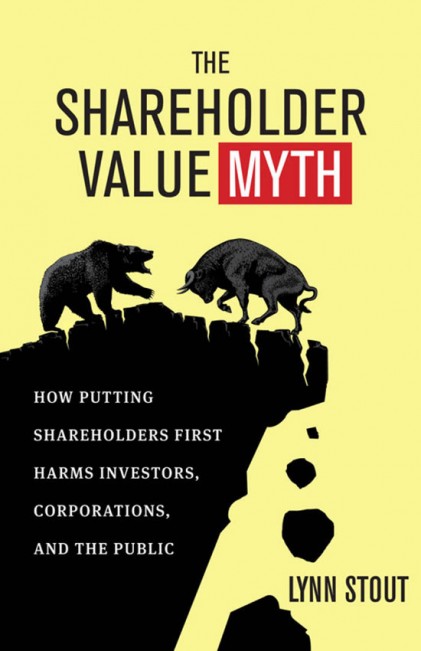
 One of the participants in the September gathering, Cornell University law professor Lynn Stout thinks not. Her book, “The Shareholder Value Myth,” argues there are at least three other corporate stakeholders – employees, communities and customers — who should be given major if not equal consideration. (VIDEO)
Drucker, in dozens of books through his lifetime, was a master of pithy advice for the corporate managers. In a series of web-site “knowledge nuggets,” begun since the September gathering, the Drucker Institute is offering some of his best, along with current intelligence in similar form.
These two “nuggets” buttress Stout’s book argument:
“The ultimate irony may be that the allegiance to shareholder value has caused the very problem it was intended to cure: enriching senior executives at the shareholders’ expense.” —Mark Kramer, Managing Director of FSG
“There’s a growing body of evidence that the companies that are most successful at maximizing shareholder value over time are those that aim toward goals other than maximizing shareholder value.”