Tag: books

  • BOOK: The “myth” of shareholder primacy stands at the brink of intellectual failure, Stout writes

    BOOK: The “myth” of shareholder primacy stands at the brink of intellectual failure, Stout writes

    Book author Lynn Stout produced The Shareholder Myth in 2012 to challenge the advancement of “shareholder value” as the exclusive guiding principle of corporations.

    Lynn Stout's book
    Lynn Stout’s book

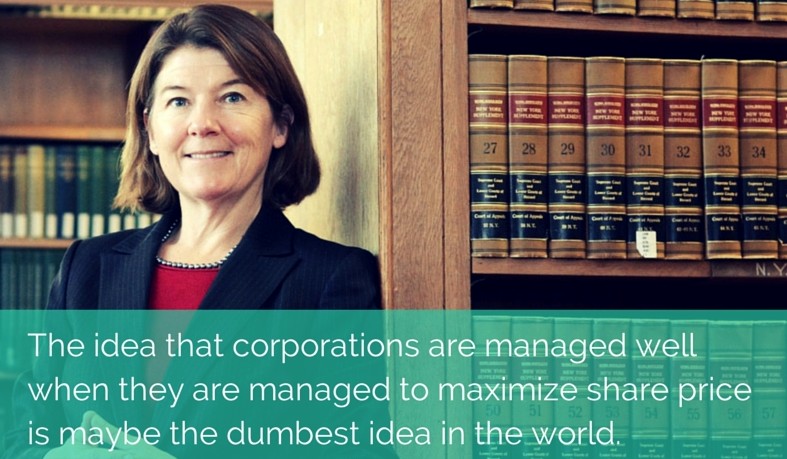
    Stout, a Cornell Law School professor, debunks the “shareholder myth” by showing how the principle of profit maximization sets corporations on an unsustainable trajectory — detracting from the well being of customers, employees, local communities, and even shareholders themselves. Stout writes that those obsessed with shareholder primacy possess “one fatal flaw” which is “the notion that corporate law requires directors, executives, and employees to maximize shareholder wealth simply isn’t true.”

    She adds: “There is no solid legal support for the claim that directors and executives in U.S. public corporations have an enforceable legal duty to maximize shareholder wealth.”

     Stout also turns to the empirical record in order to further invalidate the efficacy of the profit-maximizing firm. Stout urges caution in the face of shareholder-supporting proposals by warning of the “remarkable lack of a reliable empirical connection between shareholder-oriented governance practices and better corporate performance at the level of the individual corporation.”

    Stout was among participants in a 2013 think-tank session at the Drucker Institute.

    Instead of leading to stronger corporate performance, shareholder primacy forces managers into a “myopic” point of view where long term performance is sacrificed in the name of short term shareholder returns. For example, Stout notes the choice to cut research and development costs that fund longer-term growth as common targets of dividend-hungry investors. The result, as Stout writes, is a divergence of interests between shareholders. Investors seeking long-term returns favor corporate decisions that help prepare the company for the long road ahead rather than short-term shareholders who favor immediate and substantial returns from the company. Stout uses the analogy of fishing with dynamite to express the harmful long-term effects of divergent interests among shareholders.

    “Conventional shareholder primacy,” according to Stout, “stands on the brink of intellectual failure.” In order to survive, Stout anticipates that “it must evolve into a new, more complex, and more subtle understanding of what shareholders really want from corporations.” By pushing the boundaries of investor consciousness and challenging the restrictively narrow profit-maximizing principle of corporations, Stout’s book represents a powerful critique of shareholder primacy worthy of considerable and sustained attention.

    Stout’s book is available on Amazon here

  • BOOKS: Hedrick Smith’s 10 steps for reviving the American Dream

    BOOKS: Hedrick Smith’s 10 steps for reviving the American Dream

    When Hedrick Smith finished his draft of his best-selling book “Who Stole the American Dream,” he realized his reporter’s fact-based answer to the question his title posed left him with a deeper personal question: How could he end there, without suggesting solutions? For the twice-winner of the Pulitzer Prize for reporting, it was a sober moment. Could he as the journalist, step into the role of policy advocate? His says his wife, and his editor at Random House gave him the answer: “You must.”

    Here, summarized by Rules Change co-convenor Bill Densmore, are the suggestions Smith makes at the end of his book (printable version): 

    1. Create five million jobs through a public-private partnership to modernize America’s outdated transportation networks, just as Abraham Lincoln, Teddy Roosevelt and Dwight Eisenhower did.
    2. Start a major new national commitment to rebuild America’s capacity to out-invent and “out innovate” the world. Government funding for basic research has dropped to $1.4 billion 2006 from $9 billion in 1979 — figures adjusted for inflation.
    3. Regenerate America’s industrial manufacturing base through federal loan guarantees to help finance new energy infrastructure projects, tax credits for clean-energy manufacturing, tax changes for up-front expensing on capital investment, plant and equipment. Also institute “Buy American” policies. in the decade from 2001 to 2011 U.S. manufacturing employment fell to 11.7 million people from 17.2 million people.
    4. Make the U.S. tax code simpler and easier to enforce, increasing the capital-gains tax, and closing loopholes that favor the wealthy. The top 0.1 percent of all U.S. income earners receive almost half of all the capital gains in America so having a low capital gains tax disproportionately advantages them.
    5. Fix the corporate tax code to promote job creation at home. At 35 percent, the rate is one of the highest in the world, but various exemptions allow most corporations to pay a fraction of that, especially on foreign profits kept overseas. General Electric, for example, made nearly $10.5 billion in profits from 2008 through 2010, and instead of paying taxes, got a federal tax rebate of $4.7 billion. Apple paid $3.3 billion in taxes in 2011 on $34.2 billion in profits.
    6. Push China to float its currency live up to World Trade Organization rules on dumping, subsidies and land grants to generate four million jobs in the United States. The United States would gain 2.25 million jobs — lowering the unemployment rate by 1 percent — if China’s currency were floated and rose 25 percent against other currencies.
    7. Cut spending on overseas conflicts and reduce the Pentagon budget by $1 trillion over the next decade to fund the domestic “Marshall Plan.” The Iraq and Afghanistan wars will ultimately cost $3.5 trillion. After the Korean War, Eisenhower reduced defense spending 27 percent. After the Vietnam War, Nixon reduced it by 29 percent.
    8. Fix housing and protect the safety net. Refinance some of 22 million “under water” homes. Remove the $106,800 annual income cap on the payroll tax to better financial Social Security and Medicare.
    9. Rebuild the political center by helping ordinary Americans to re-engage with the political system — possibly with third-party, independent movements. Two-thirds of Americans (including 55% of Republicans) now say there are “strong” conflicts between rich and poor — up roughly 20 percent from just two years ago. Key requirements: Online registration, non-partisan redistricting, and open or nonpartisan primaries.
    10. Foster a rebirth of citizen involvement, activism and American idealism, by holding government accountable, and by sending a larger share of America’s national income to average Americans. Restore credibility by fairly handling housing, closing corporate tax loopholes, raising taxes on the rich, and imposing new fees on Wall Street’s stock transactions and executive stock options.