Tag: equity

  • The Burden of Student Loans

    The Burden of Student Loans

    The problem of growing student-loan debt has surfaced as one of the major issues facing our country, because they are creating a class of Americans — some of them now elderly — who are burdened from young adulthood with debt and therefore forced to make career decisions with that in mind.

    Student loans (BACKGROUND) offer both young Americans and parents an avenue through which they can afford the rising costs of colleges and universities. A college degree, however, no longer ensures employment for young graduates who consequentially find it more difficult to keep up with their payments. For the first time in history, U.S. student-loan debt is over $1 trillion. The federal government is seeing an increased number of delayed payments on loans.[1]

    SOURCES: www.kansascityfed.org/publicat/reswkpap/pdf/rwp%2012-05.pdf?wf=rs082712; Federal Reserve Bank of New York Consumer Credit Panel and Equifax.
    SOURCES: www.kansascityfed.org/publicat/reswkpap/pdf/rwp%2012-05.pdf?wf=rs082712; Federal Reserve Bank of New York Consumer Credit Panel and Equifax.

    Student loan policy is an example of how bureaucratic interest can drive real policy. An article published in 2003 by the U.S. News and World Report took a behind-the-scenes look at the political lobbyists who were pushing the burden of student loans on American taxpayers in return for big profits from Federal Family Education Loans (FFEL) loans. From 2000 to 2003 lobbyists had convinced over 62 colleges to drop out of the direct loans program.[2] The larger private organizations that serviced student loans, such as Sallie Mae, used profits to increase their presence in Washington, particularly with Republicans. It is reported that Sallie Mae has spent close to $6 million on political contributions from 1992 to 2012.[3]

    With the Democrats in control of Congress, Obama signed the Affordable Care Act that effectively ended the guaranteed loans program by eliminating any FFEL loans after July 1, 2010.[4] The decision to end the FFEL program is estimated to save $68.7 billion over the next 10 years.[5]

    While 2010 represented a major change in the student loan policy, the problem of a huge and growing debt still exists. Students from the class of 2014 graduated school with an average debt of $26,600 a person.[6] There are also an estimated two million Americans age 60 and older that are still in debt from student loans, and the size of that debt has grown from eight to $43 billion between 2005-2014.[7], especially from for-profit schools. The rules change that eliminated guaranteed loans certainly was the most significant student loan policy change to date. However, there is still clearly much remaining policy work to be done in order to realize President Obama’s hope that, “People who have the grades, the desire and the will, but not the money, can still get the best education possible.”

    RELATED LINKS:

    FOOTNOTES:

  • GWO gathering builds knowledge, support for “fourth sector” businesses combining profit, social benefits; sector seen as growing at twice rate of profit-only entities

    GWO gathering builds knowledge, support for “fourth sector” businesses combining profit, social benefits; sector seen as growing at twice rate of profit-only entities

    CONFERENCE NOTES: 
    PART ONE / PART TWO / PART THREE / BACKGROUND

    WASHINGTON, D.C. — Some 200 scholars, public officials, researchers, funders and practitioners — supported by the Federal Reserve Board, George Washington University and others – kicked off an initiative to help prove that capitalists are doing well by doing good – in what they call the “fourth-sector” economy.

    “Mapping the Fourth Sector,” was a one-day, invitation-only brainstorming session (open to media) held Jan. 15, 2015 at the university’s Trachtenberg School of Public Policy organized by a group called the Fourth Sector Network. Other supporters of the gathering included the B Team and the Urban Institute.

    There’s growing recognition of the fourth sector’s potential for delivering solutions to a broad array of social, environmental, and economic challenges,” said retired GWU President Stephen Trachtenberg.   “These include job creation and sustainable economic development to climate change, health care, education, social services, energy and more.”

    The morning featured on-the-record panel presentations with speakers including Don Graves, Deputy Assistant to the President; Kathy Calvin, President and CEO of the UN Foundation; Robert Forrester, Chairman & CEO of Newman’s Own Inc.; Mark Prater, Chief Tax Counsel for the Senate Finance Committee; among others.”

    “Fourth sector” is a term used by some experts to described companies chartered to make a profit at the same time they are pledged to serve one or more social purposes. They are distinct from the three other economic sectors — government, non-profit, and purely profit-making businesses. Organizers want to make sure legal forms and support systems for such organizations are thriving. Well-known examples including Newmans Own Inc.

    “These organizations are creating jobs and their growth rate is almost twice as fast as pure-profit  businesses in the first,” Heerad Sabeti, a Fourth Sector Network co-founder and himself a Raleigh, N.C., entrepreneur, said a few days before the event. “How many are there? That is one thing the mapping initiative is going to tell us — it could be 10% or 20% of GDP already. And they are working to solve social and environmental problems in the process.”

    “As the lines between public, private and nonprofit sectors blur, a fourth sector is emerging that strives to contribute to economic growth while solving social and environmental problems. said Elizabeth T. Boris, a director at the Urban Institute, which was preparing the data map.   “It has the potential for generating immense economic, social and environmental benefits. The mapping project is designed to bring them broader public recognition and engagement.”

    Companies organized in the forth sector are often called “for-benefit” corporations – or “B corps.” They are typically driven to achieve environmental, community, justice or equity goals. They include sustainable businesses, social enterprises, municipal enterprises, community development corporations, social businesses and other models.

    “These efforts are hampered by lack of adequate data and analysis,” says Sabeti.   “Research will help policymakers understand the barriers they face and what would promote their growth and impact.”

    In May 2013, Sabeti’s team staged a gathering at the Harvard Business School called “Growing the Impact Economy.” One outcome was a grant to the Urban Institute to create a systematic method – a “taxonomy” — for categorizing and listing “Fourth Sector” entities. At Thursday’s event, participants will get a preview of the mapping project, which will become public later this year.

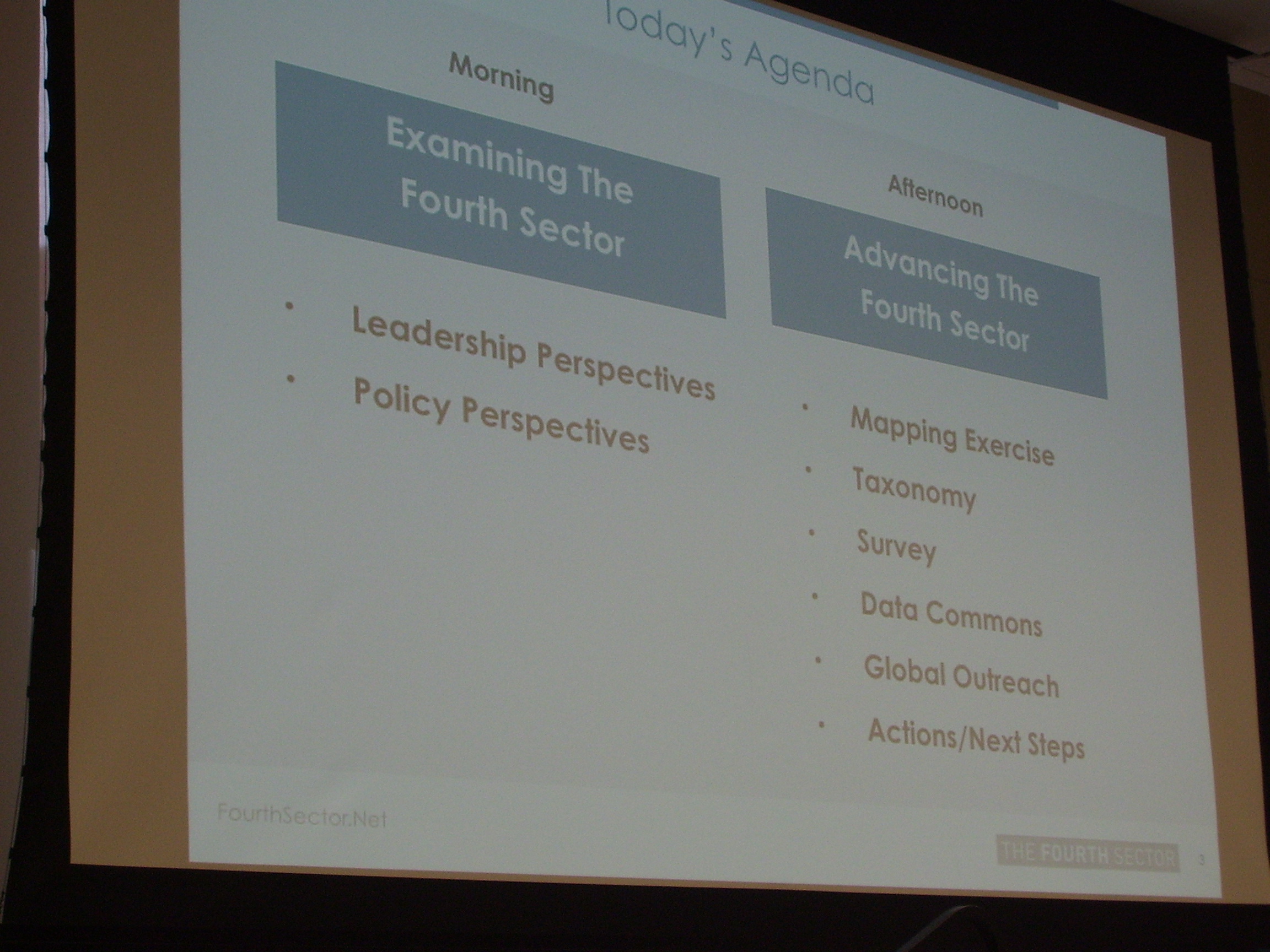
    Following morning session of updates from the speakers, “Mapping the Fourth Sector” participants spent the afternoon in roundtable breakouts, seeking answers to at least four key questions:

    • What distinguishes the Fourth Sector from the private, public and nonprofit sectors? What differentiates various types of for-benefit organizations from each other?
    • How does the Fourth Sector contribute to job and enterprise creation, economic development?
    • What obstacles do for-benefit organizations face and what enabling policies and infrastructure are needed to address them, both regionally and nationally?
    • What can fill the gaps in data and understanding required by public agencies, practitioners, researchers, investors, economic developers and other stakeholders?

    — 30 –

    CONFERENCE NOTES: 
    PART ONE / PART TWO / PART THREE / BACKGROUND

    MEDIA CONTACTS:
    Laura Greenback, Urban Institute, (202) 261-5709, lgreenback@urban.org
    Heerad Sabeti, Fourth Sector Network, 919-426-7722, h.sabeti@forbenefit.net

    EVENT CONVENORS:

    The B Team
    The B Team is a not-for-profit initiative formed by a global group of leaders to create a future where the purpose of business is to be a driving force for social, environmental and economic benefit.

    Federal Reserve Board of Governors
    The Federal Reserve, the central bank of the United States, is a federal system composed of a central governmental agency—the Board of Governors—and 12 regional Federal Reserve Banks. Besides conducting research, analysis, and policymaking related to domestic and international financial and economic matters, the Board plays a major role in the supervision and regulation of U.S. financial institutions and activities, has broad oversight responsibility for the nation’s payments system and the operations and activities of the Federal Reserve Banks, and plays an important role in promoting consumer protection, fair lending, and community development.

    The Urban Institute
    The nonprofit Urban Institute is dedicated to elevating the debate on social and economic policy. For nearly five decades, Urban scholars have conducted research and delivered evidence-based solutions that improve lives, strengthen communities, and increase the effectiveness of public policy. Their objective research helps expand opportunities for all, reduce hardship among the most vulnerable, and strengthen the fiscal health of government across a rapidly urbanizing world.

    Trachtenberg School of Public Policy and Public Administration
    The Trachtenberg School in GWU’s Columbian College of Arts and Sciences is a focal point for public affairs education, research and public service at the George Washington University. Building on a rich tradition of education for public service and on its location in the nation’s capital, just a few blocks west of the White House, the George Washington University offers a superior education for students wishing to pursue public affairs-oriented academic programs.

    RELATED LINKS:

    Story about 2013 conference at Harvard University:
    http://www.csrwire.com/press_releases/35643-Boosting-the-Fourth-sector-Economy-is-Goal-of-200-delegate-Summit-at-Harvard

    Chart: For-Benefit Enterprises and the Fourth Sector:
    http://www.fourthsector.net/learn
    http://www.fourthsector.net/assets/1/fourth-sector_large.jpg

    Read profiles of Fourth Sector businesses:
    http://gamechangers500.com/

    “The Emerging Fourth Sector” (2009 study by The Aspen Institute):
    https://www.aspeninstitute.org/sites/default/files/content/docs/pubs/4th%20sector%20paper%20-%20exec%20summary%20FINAL.pdf

    Report of a 2008 meeting on Fourth Sector legal forms:
    http://www.perlmanandperlman.com/publications/articles/2008/FourthSector.pdf

    IMAGE: Fourth Sector LOGO o
    http://www.ggem-microfinancesl.org/communities/6/004/010/200/376/images/4572993329_pre.jpg

  • Elizabeth Murdoch: Money not the only “effective measure of all things” or free market “only sorting mechanism”

    Elizabeth Murdoch: Money not the only “effective measure of all things” or free market “only sorting mechanism”

    “As an industry — and indeed as a global society — we have become trapped in our own rhetoric. We need to learn how to be comfortable with articulating purpose and reject the idea that money is the only effective measure of all things or that the free market is the only sorting mechanism.” — Elisabeth Murdoch, executive.

    “There is one and only social responsibility of business — to use its resoures and engage in activities designed to increase its profits so long as it stays within the rules of the game, which is to say, engages in open and free competition without deception or fraud.” — Milton Friedman, economist. 

    Friedman’s line of thinking  has informed the beliefs of many of the titans of capitalism who claim that, no matter the negative impacts of their businesses, they are merely playing their part in the capitalist system. Titans such as Rupert Murdoch, the telecommunications giant who is currently #69 on the Forbes Billionaire List with a net worth of $13.8 billion.  Murdoch has found himself in the headlines in the past for engaging in questionable practices in the pursuit of profits as his newspapers were investigated for hacking the cellphones of British celebrities, royalty and even regular citizens.

    It is instances like this that cause one to challenge Friedman’s concept that the pursuit of profits are businesses only responsibility. However, there are business leaders who offer an alternative to this concept, some of whom come as quite a surprise. One of them is Murdoch’s daughter, Elisabeth,  and the CEO of Shine Limited, which stands for more than the pursuit of profits. In 2012, Ms. Murdoch delivered the keynote address at the GuardianMedia Edinburgh International Television Festival and surprised many with the message she sent. Her overall thesis can be best summarized by her quote that, “Profit without purpose is a recipe for disaster.” The speech can be found in it’s entirety here. She said:  “As an industry — and indeed as a global society — we have become trapped in our own rhetoric. We need to learn how to be comfortable with articulating purpose and reject the idea that money is the only effective measure of all things or that the free market is the only sorting mechanism.”  She added:

    “Do we have such faith in the imperatives of the market that we need have no will of our own other than to succeed on its terms? It is increasingly apparent that the absence of purpose — or of a moral language — within government, media or business could become one of the most dangerous own goals for capitalism and freedom.”

    It is important to keep in mind that in 2011 Elisabeth sold Shine Limited to her father’s News Corporation. She said the sale was necsary to achieve scale in the increasingly digitized media industry. Murdoch is seen as the possible future head of her father’s empire.

  • Ron Shaich’s “Panera Cares” experiments with “pay-what-you-can” to help with food insecurity

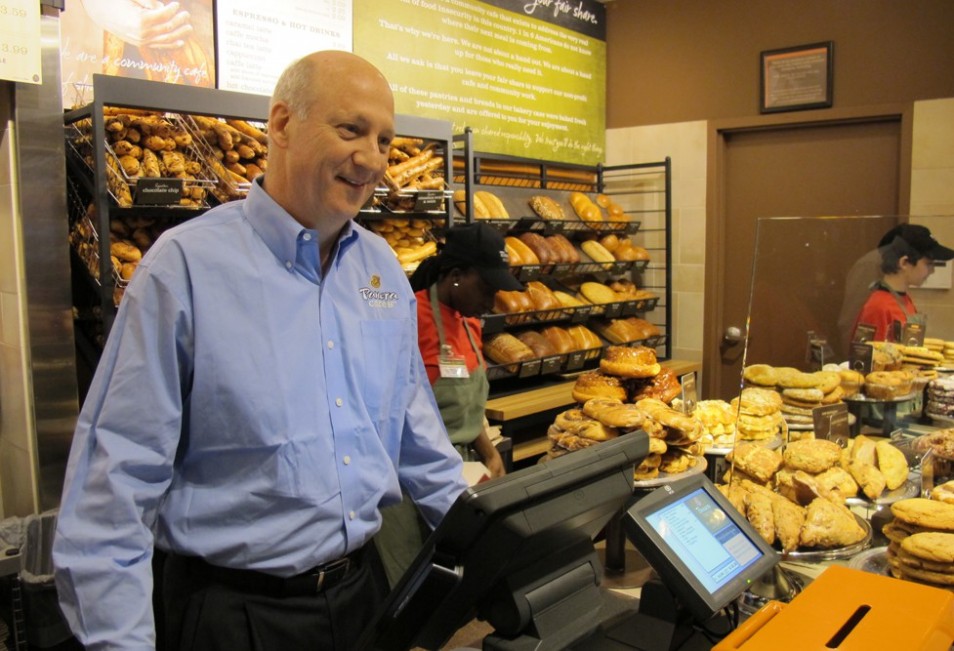
    Ron Shaich’s “Panera Cares” experiments with “pay-what-you-can” to help with food insecurity


    Ron Shaich built a major business — Au Bon Pain, then sold it off. While you’ve probably heard of Panera Bread, the popular national bakery/café chain — his second venture — you may not have heard of Panera Cares. The Panera Cares Cafes are only open in select locations and they do business differently. At these cafes the cash registers have been replaced by donation bins, the price list has been replaced by suggested donation amounts (equivalent to retail value at other Panera restaurants) and food is available to all regardless of ability to pay. The Panera Cares website cites that “49 million people – including 16 million children — are food insecure. That means that 1 in 7 households have difficulty providing enough food for all their members at some time during the year.” Thus Panera Cares uses a pay-what-you-can model to help those who struggle with food insecurity.