CONFERENCE NOTES:
PART ONE / PART TWO / PART THREE / BACKGROUND
WASHINGTON, D.C. — Some 200 scholars, public officials, researchers, funders and practitioners — supported by the Federal Reserve Board, George Washington University and others – kicked off an initiative to help prove that capitalists are doing well by doing good – in what they call the “fourth-sector” economy.
“Mapping the Fourth Sector,” was a one-day, invitation-only brainstorming session (open to media) held Jan. 15, 2015 at the university’s Trachtenberg School of Public Policy organized by a group called the Fourth Sector Network. Other supporters of the gathering included the B Team and the Urban Institute.
“There’s growing recognition of the fourth sector’s potential for delivering solutions to a broad array of social, environmental, and economic challenges,” said retired GWU President Stephen Trachtenberg. “These include job creation and sustainable economic development to climate change, health care, education, social services, energy and more.”
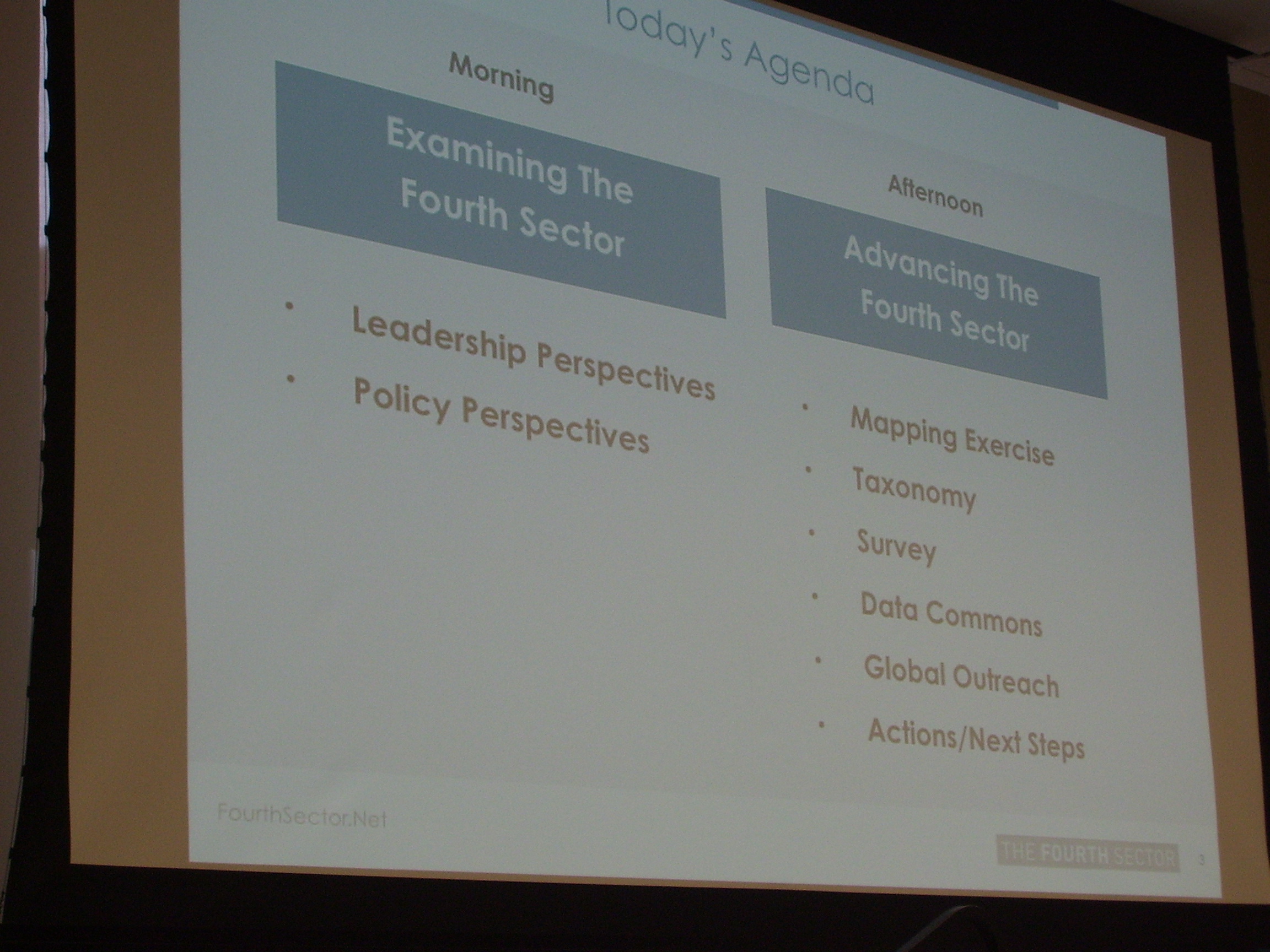
The morning featured on-the-record panel presentations with speakers including Don Graves, Deputy Assistant to the President; Kathy Calvin, President and CEO of the UN Foundation; Robert Forrester, Chairman & CEO of Newman’s Own Inc.; Mark Prater, Chief Tax Counsel for the Senate Finance Committee; among others.”
“Fourth sector” is a term used by some experts to described companies chartered to make a profit at the same time they are pledged to serve one or more social purposes. They are distinct from the three other economic sectors — government, non-profit, and purely profit-making businesses. Organizers want to make sure legal forms and support systems for such organizations are thriving. Well-known examples including Newmans Own Inc.
“These organizations are creating jobs and their growth rate is almost twice as fast as pure-profit businesses in the first,” Heerad Sabeti, a Fourth Sector Network co-founder and himself a Raleigh, N.C., entrepreneur, said a few days before the event. “How many are there? That is one thing the mapping initiative is going to tell us — it could be 10% or 20% of GDP already. And they are working to solve social and environmental problems in the process.”
“As the lines between public, private and nonprofit sectors blur, a fourth sector is emerging that strives to contribute to economic growth while solving social and environmental problems. said Elizabeth T. Boris, a director at the Urban Institute, which was preparing the data map. “It has the potential for generating immense economic, social and environmental benefits. The mapping project is designed to bring them broader public recognition and engagement.”
Companies organized in the forth sector are often called “for-benefit” corporations – or “B corps.” They are typically driven to achieve environmental, community, justice or equity goals. They include sustainable businesses, social enterprises, municipal enterprises, community development corporations, social businesses and other models.
“These efforts are hampered by lack of adequate data and analysis,” says Sabeti. “Research will help policymakers understand the barriers they face and what would promote their growth and impact.”
In May 2013, Sabeti’s team staged a gathering at the Harvard Business School called “Growing the Impact Economy.” One outcome was a grant to the Urban Institute to create a systematic method – a “taxonomy” — for categorizing and listing “Fourth Sector” entities. At Thursday’s event, participants will get a preview of the mapping project, which will become public later this year.
Following morning session of updates from the speakers, “Mapping the Fourth Sector” participants spent the afternoon in roundtable breakouts, seeking answers to at least four key questions:
- What distinguishes the Fourth Sector from the private, public and nonprofit sectors? What differentiates various types of for-benefit organizations from each other?
- How does the Fourth Sector contribute to job and enterprise creation, economic development?
- What obstacles do for-benefit organizations face and what enabling policies and infrastructure are needed to address them, both regionally and nationally?
- What can fill the gaps in data and understanding required by public agencies, practitioners, researchers, investors, economic developers and other stakeholders?
— 30 –
CONFERENCE NOTES:
PART ONE / PART TWO / PART THREE / BACKGROUND
MEDIA CONTACTS:
Laura Greenback, Urban Institute, (202) 261-5709, lgreenback@urban.org
Heerad Sabeti, Fourth Sector Network, 919-426-7722, h.sabeti@forbenefit.net
EVENT CONVENORS:
The B Team
The B Team is a not-for-profit initiative formed by a global group of leaders to create a future where the purpose of business is to be a driving force for social, environmental and economic benefit.
Federal Reserve Board of Governors
The Federal Reserve, the central bank of the United States, is a federal system composed of a central governmental agency—the Board of Governors—and 12 regional Federal Reserve Banks. Besides conducting research, analysis, and policymaking related to domestic and international financial and economic matters, the Board plays a major role in the supervision and regulation of U.S. financial institutions and activities, has broad oversight responsibility for the nation’s payments system and the operations and activities of the Federal Reserve Banks, and plays an important role in promoting consumer protection, fair lending, and community development.
The Urban Institute
The nonprofit Urban Institute is dedicated to elevating the debate on social and economic policy. For nearly five decades, Urban scholars have conducted research and delivered evidence-based solutions that improve lives, strengthen communities, and increase the effectiveness of public policy. Their objective research helps expand opportunities for all, reduce hardship among the most vulnerable, and strengthen the fiscal health of government across a rapidly urbanizing world.
Trachtenberg School of Public Policy and Public Administration
The Trachtenberg School in GWU’s Columbian College of Arts and Sciences is a focal point for public affairs education, research and public service at the George Washington University. Building on a rich tradition of education for public service and on its location in the nation’s capital, just a few blocks west of the White House, the George Washington University offers a superior education for students wishing to pursue public affairs-oriented academic programs.
RELATED LINKS:
Story about 2013 conference at Harvard University:
http://www.csrwire.com/press_releases/35643-Boosting-the-Fourth-sector-Economy-is-Goal-of-200-delegate-Summit-at-Harvard
Chart: For-Benefit Enterprises and the Fourth Sector:
http://www.fourthsector.net/learn
http://www.fourthsector.net/assets/1/fourth-sector_large.jpg
Read profiles of Fourth Sector businesses:
http://gamechangers500.com/
“The Emerging Fourth Sector” (2009 study by The Aspen Institute):
https://www.aspeninstitute.org/sites/default/files/content/docs/pubs/4th%20sector%20paper%20-%20exec%20summary%20FINAL.pdf
Report of a 2008 meeting on Fourth Sector legal forms:
http://www.perlmanandperlman.com/publications/articles/2008/FourthSector.pdf
IMAGE: Fourth Sector LOGO o
http://www.ggem-microfinancesl.org/communities/6/004/010/200/376/images/4572993329_pre.jpg