Month: January 2015

  • STUDY: Low-income students in households making less than $28K annually now a majority in the nation’s public schools

    STUDY: Low-income students in households making less than $28K annually now a majority in the nation’s public schools

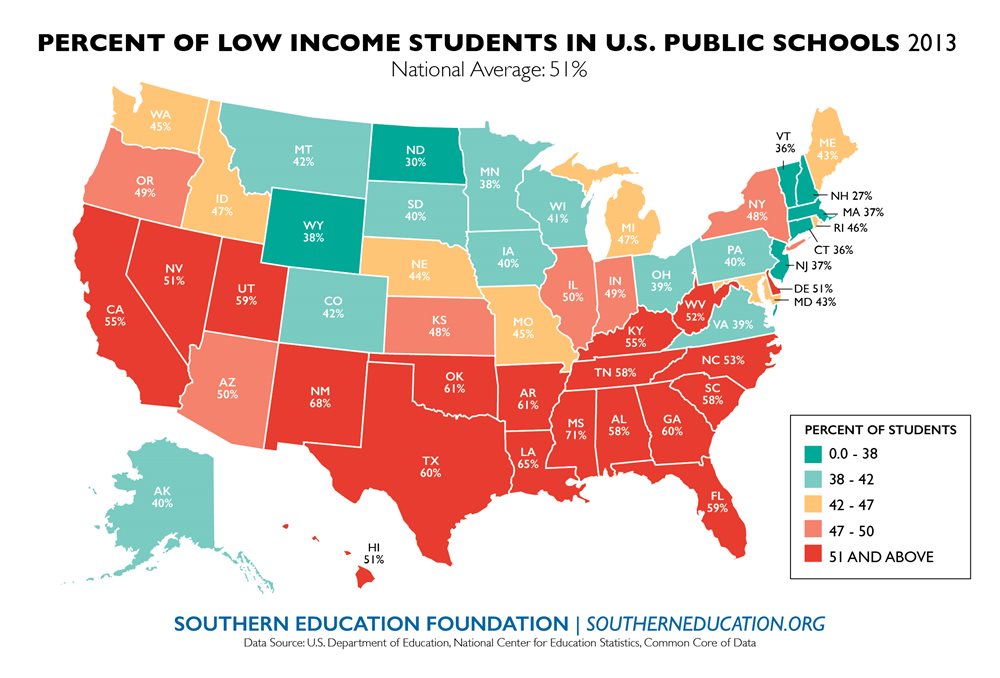
    Low-income students — those living in a single-parent household earning less than $28,000 a year — are now a majority of the schoolchildren attending the nation’s public schools, according to new analysis of state data compiled and analyzed in a January, 2015, report from the Southern Education Research Foundation.  The January, 2015,  report is based on data available from the federal government’s National Center for Education Statistics (NCES). It shows that, as of 2013, 51 percent of the students across the nation’s public schools were low income in 2013.

    “In 40 of the 50 states, low-income students comprised no less than 40 percent of all public schoolchildren. In 21 states, children eligible for free or reduced-price lunches were a majority of the students in 2013,” says a report on the NCES-collected data in the study written by the Southern Education Foundation. 

    A Washington Post article written by Lindsey Layton covered the Southern Education Research Foundation report. Layton wrote: “The shift to a majority-poor student population means that in public schools, a growing number of children start kindergarten already trailing their more privileged peers and rarely, if ever, catch up. They are less likely to have support at home, are less frequently exposed to enriching activities outside of school, and are more likely to drop out and never attend college.”

    Education is portrayed as the most effective weapon in the fight against inequality. The article quotes Darren Walker, the president of the Ford Foundation voicing his concern:

    “Even at 8 or 9 years old, I knew that America wanted me to succeed,” he said. “What we know is that the mobility escalator has simply stopped for some Americans. I was able to ride that mobility escalator in part because there were so many people, and parts of our society, cheering me on . . . we need to fix the escalator. We fix it by recommitting ourselves to the idea of public education. We have the capacity. The question is, do we have the will?”

    What is low income? The SERF report used eligibility for free or reduced lunch to define low income.  The researchers wrote that: “Students are eligible for free meals at public schools if they live in households where the income is no more than 135 percent of the poverty threshold. They are eligible for reduced-price lunches if their household income is no more than 185 percent. In 2013, for example, a student in a household with a single parent with an annual income of less than $19,669 was eligible for a free lunch or less than $27,991 for a reduced-price meal in a public school.”

  • BOOK: The “myth” of shareholder primacy stands at the brink of intellectual failure, Stout writes

    BOOK: The “myth” of shareholder primacy stands at the brink of intellectual failure, Stout writes

    Book author Lynn Stout produced The Shareholder Myth in 2012 to challenge the advancement of “shareholder value” as the exclusive guiding principle of corporations.

    Lynn Stout's book
    Lynn Stout’s book

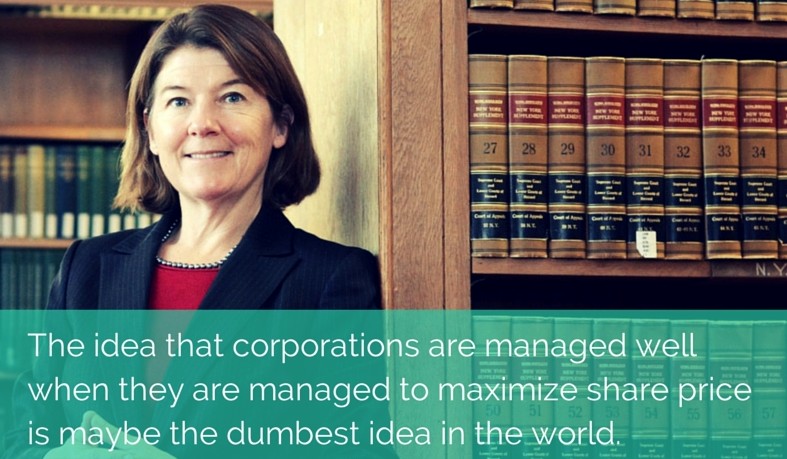
    Stout, a Cornell Law School professor, debunks the “shareholder myth” by showing how the principle of profit maximization sets corporations on an unsustainable trajectory — detracting from the well being of customers, employees, local communities, and even shareholders themselves. Stout writes that those obsessed with shareholder primacy possess “one fatal flaw” which is “the notion that corporate law requires directors, executives, and employees to maximize shareholder wealth simply isn’t true.”

    She adds: “There is no solid legal support for the claim that directors and executives in U.S. public corporations have an enforceable legal duty to maximize shareholder wealth.”

     Stout also turns to the empirical record in order to further invalidate the efficacy of the profit-maximizing firm. Stout urges caution in the face of shareholder-supporting proposals by warning of the “remarkable lack of a reliable empirical connection between shareholder-oriented governance practices and better corporate performance at the level of the individual corporation.”

    Stout was among participants in a 2013 think-tank session at the Drucker Institute.

    Instead of leading to stronger corporate performance, shareholder primacy forces managers into a “myopic” point of view where long term performance is sacrificed in the name of short term shareholder returns. For example, Stout notes the choice to cut research and development costs that fund longer-term growth as common targets of dividend-hungry investors. The result, as Stout writes, is a divergence of interests between shareholders. Investors seeking long-term returns favor corporate decisions that help prepare the company for the long road ahead rather than short-term shareholders who favor immediate and substantial returns from the company. Stout uses the analogy of fishing with dynamite to express the harmful long-term effects of divergent interests among shareholders.

    “Conventional shareholder primacy,” according to Stout, “stands on the brink of intellectual failure.” In order to survive, Stout anticipates that “it must evolve into a new, more complex, and more subtle understanding of what shareholders really want from corporations.” By pushing the boundaries of investor consciousness and challenging the restrictively narrow profit-maximizing principle of corporations, Stout’s book represents a powerful critique of shareholder primacy worthy of considerable and sustained attention.

    Stout’s book is available on Amazon here

  • CalPERS pension fund includes public interest as central to investing decisions

    CalPERS pension fund includes public interest as central to investing decisions

    The changing relationship between corporations and society is at play in the evolving investing strategies of pension funds.

    CalPERS CEO Ann Stausboll
    CalPERS CEO Ann Stausboll

    Rather than electing to exclusively pursue the strongest possible financial returns, some pension funds are investing with other concerns in mind. When CalPERS adopted a set of investment principles Amanda White reported on the announcement. In 2013 California’s largest pension fund published a list of formal investment principles that included an expanded definition of fiduciary responsibilities.

    According to CalPERS chief executive Ann Stausboll, “The fiduciary responsibility of pension funds should extend to issues outside the parameters typically understood as being directly related to beneficiaries’ financial interest, says to CalPERS chief executive Ann Stausboll. “It is our job to make sure investors, businesses and policymakers are responding aggressively and creatively to the opportunities associated with climate change and other sustainability issues.”

    In step with companies such as Patagonia, CalPERS has emerged as a bold innovator by adopting a more comprehensive view corporate purpose. Patagonia uses “flex hours” in order to enable employees to live active lifestyles. As CalPERS, Patagionia, and other companies continue to broaden their corporate philosophies beyond exclusively serving the interests of shareholders, policymakers also evaluate the existing rules in order to accommodate the changing understanding of corporate purpose.

  • GWO gathering builds knowledge, support for “fourth sector” businesses combining profit, social benefits; sector seen as growing at twice rate of profit-only entities

    GWO gathering builds knowledge, support for “fourth sector” businesses combining profit, social benefits; sector seen as growing at twice rate of profit-only entities

    CONFERENCE NOTES: 
    PART ONE / PART TWO / PART THREE / BACKGROUND

    WASHINGTON, D.C. — Some 200 scholars, public officials, researchers, funders and practitioners — supported by the Federal Reserve Board, George Washington University and others – kicked off an initiative to help prove that capitalists are doing well by doing good – in what they call the “fourth-sector” economy.

    “Mapping the Fourth Sector,” was a one-day, invitation-only brainstorming session (open to media) held Jan. 15, 2015 at the university’s Trachtenberg School of Public Policy organized by a group called the Fourth Sector Network. Other supporters of the gathering included the B Team and the Urban Institute.

    There’s growing recognition of the fourth sector’s potential for delivering solutions to a broad array of social, environmental, and economic challenges,” said retired GWU President Stephen Trachtenberg.   “These include job creation and sustainable economic development to climate change, health care, education, social services, energy and more.”

    The morning featured on-the-record panel presentations with speakers including Don Graves, Deputy Assistant to the President; Kathy Calvin, President and CEO of the UN Foundation; Robert Forrester, Chairman & CEO of Newman’s Own Inc.; Mark Prater, Chief Tax Counsel for the Senate Finance Committee; among others.”

    “Fourth sector” is a term used by some experts to described companies chartered to make a profit at the same time they are pledged to serve one or more social purposes. They are distinct from the three other economic sectors — government, non-profit, and purely profit-making businesses. Organizers want to make sure legal forms and support systems for such organizations are thriving. Well-known examples including Newmans Own Inc.

    “These organizations are creating jobs and their growth rate is almost twice as fast as pure-profit  businesses in the first,” Heerad Sabeti, a Fourth Sector Network co-founder and himself a Raleigh, N.C., entrepreneur, said a few days before the event. “How many are there? That is one thing the mapping initiative is going to tell us — it could be 10% or 20% of GDP already. And they are working to solve social and environmental problems in the process.”

    “As the lines between public, private and nonprofit sectors blur, a fourth sector is emerging that strives to contribute to economic growth while solving social and environmental problems. said Elizabeth T. Boris, a director at the Urban Institute, which was preparing the data map.   “It has the potential for generating immense economic, social and environmental benefits. The mapping project is designed to bring them broader public recognition and engagement.”

    Companies organized in the forth sector are often called “for-benefit” corporations – or “B corps.” They are typically driven to achieve environmental, community, justice or equity goals. They include sustainable businesses, social enterprises, municipal enterprises, community development corporations, social businesses and other models.

    “These efforts are hampered by lack of adequate data and analysis,” says Sabeti.   “Research will help policymakers understand the barriers they face and what would promote their growth and impact.”

    In May 2013, Sabeti’s team staged a gathering at the Harvard Business School called “Growing the Impact Economy.” One outcome was a grant to the Urban Institute to create a systematic method – a “taxonomy” — for categorizing and listing “Fourth Sector” entities. At Thursday’s event, participants will get a preview of the mapping project, which will become public later this year.

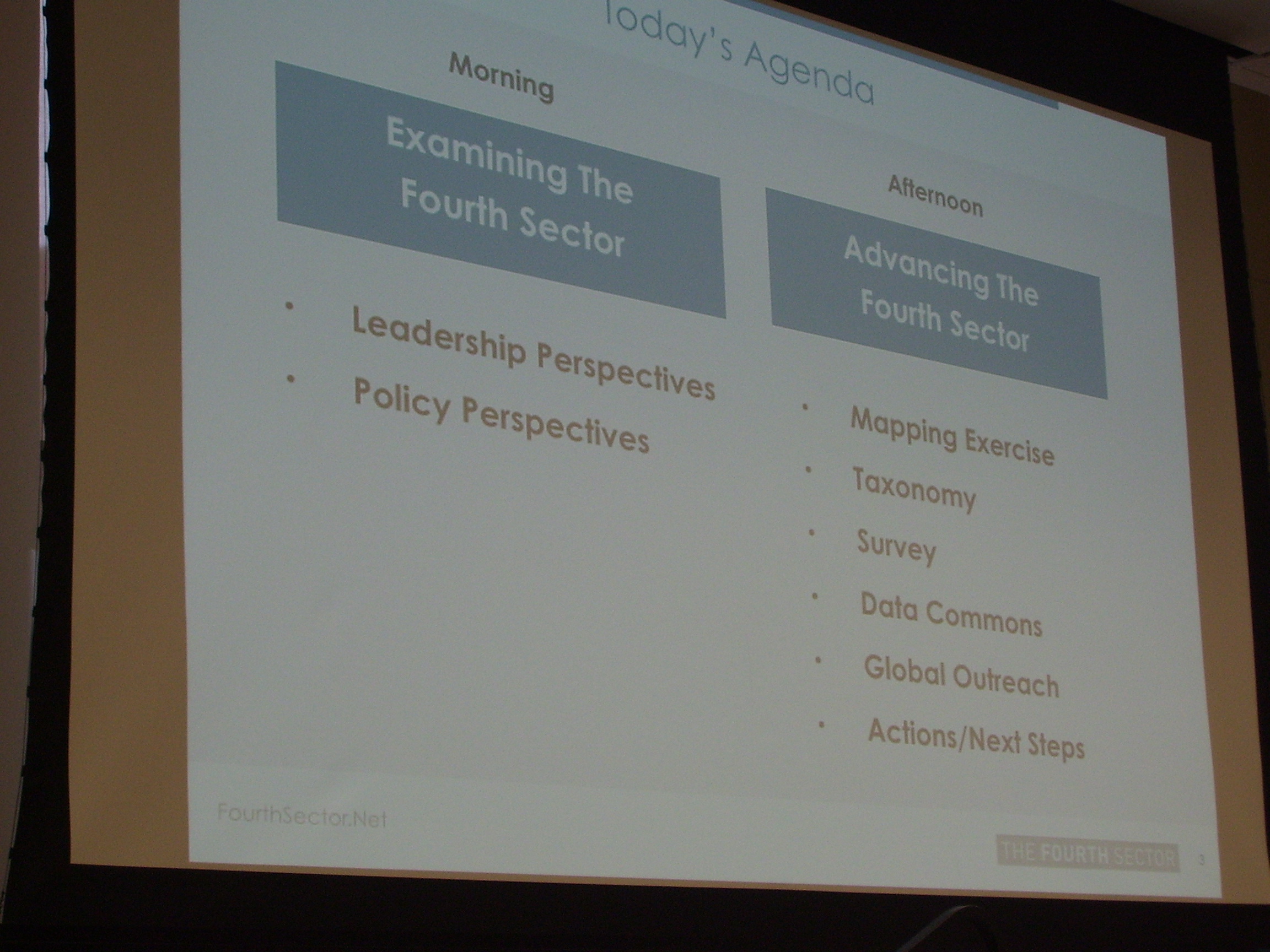
    Following morning session of updates from the speakers, “Mapping the Fourth Sector” participants spent the afternoon in roundtable breakouts, seeking answers to at least four key questions:

    • What distinguishes the Fourth Sector from the private, public and nonprofit sectors? What differentiates various types of for-benefit organizations from each other?
    • How does the Fourth Sector contribute to job and enterprise creation, economic development?
    • What obstacles do for-benefit organizations face and what enabling policies and infrastructure are needed to address them, both regionally and nationally?
    • What can fill the gaps in data and understanding required by public agencies, practitioners, researchers, investors, economic developers and other stakeholders?

    — 30 –

    CONFERENCE NOTES: 
    PART ONE / PART TWO / PART THREE / BACKGROUND

    MEDIA CONTACTS:
    Laura Greenback, Urban Institute, (202) 261-5709, lgreenback@urban.org
    Heerad Sabeti, Fourth Sector Network, 919-426-7722, h.sabeti@forbenefit.net

    EVENT CONVENORS:

    The B Team
    The B Team is a not-for-profit initiative formed by a global group of leaders to create a future where the purpose of business is to be a driving force for social, environmental and economic benefit.

    Federal Reserve Board of Governors
    The Federal Reserve, the central bank of the United States, is a federal system composed of a central governmental agency—the Board of Governors—and 12 regional Federal Reserve Banks. Besides conducting research, analysis, and policymaking related to domestic and international financial and economic matters, the Board plays a major role in the supervision and regulation of U.S. financial institutions and activities, has broad oversight responsibility for the nation’s payments system and the operations and activities of the Federal Reserve Banks, and plays an important role in promoting consumer protection, fair lending, and community development.

    The Urban Institute
    The nonprofit Urban Institute is dedicated to elevating the debate on social and economic policy. For nearly five decades, Urban scholars have conducted research and delivered evidence-based solutions that improve lives, strengthen communities, and increase the effectiveness of public policy. Their objective research helps expand opportunities for all, reduce hardship among the most vulnerable, and strengthen the fiscal health of government across a rapidly urbanizing world.

    Trachtenberg School of Public Policy and Public Administration
    The Trachtenberg School in GWU’s Columbian College of Arts and Sciences is a focal point for public affairs education, research and public service at the George Washington University. Building on a rich tradition of education for public service and on its location in the nation’s capital, just a few blocks west of the White House, the George Washington University offers a superior education for students wishing to pursue public affairs-oriented academic programs.

    RELATED LINKS:

    Story about 2013 conference at Harvard University:
    http://www.csrwire.com/press_releases/35643-Boosting-the-Fourth-sector-Economy-is-Goal-of-200-delegate-Summit-at-Harvard

    Chart: For-Benefit Enterprises and the Fourth Sector:
    http://www.fourthsector.net/learn
    http://www.fourthsector.net/assets/1/fourth-sector_large.jpg

    Read profiles of Fourth Sector businesses:
    http://gamechangers500.com/

    “The Emerging Fourth Sector” (2009 study by The Aspen Institute):
    https://www.aspeninstitute.org/sites/default/files/content/docs/pubs/4th%20sector%20paper%20-%20exec%20summary%20FINAL.pdf

    Report of a 2008 meeting on Fourth Sector legal forms:
    http://www.perlmanandperlman.com/publications/articles/2008/FourthSector.pdf

    IMAGE: Fourth Sector LOGO o
    http://www.ggem-microfinancesl.org/communities/6/004/010/200/376/images/4572993329_pre.jpg
  • Elizabeth Murdoch: Money not the only “effective measure of all things” or free market “only sorting mechanism”

    Elizabeth Murdoch: Money not the only “effective measure of all things” or free market “only sorting mechanism”

    “As an industry — and indeed as a global society — we have become trapped in our own rhetoric. We need to learn how to be comfortable with articulating purpose and reject the idea that money is the only effective measure of all things or that the free market is the only sorting mechanism.” — Elisabeth Murdoch, executive.

    “There is one and only social responsibility of business — to use its resoures and engage in activities designed to increase its profits so long as it stays within the rules of the game, which is to say, engages in open and free competition without deception or fraud.” — Milton Friedman, economist. 

    Friedman’s line of thinking  has informed the beliefs of many of the titans of capitalism who claim that, no matter the negative impacts of their businesses, they are merely playing their part in the capitalist system. Titans such as Rupert Murdoch, the telecommunications giant who is currently #69 on the Forbes Billionaire List with a net worth of $13.8 billion.  Murdoch has found himself in the headlines in the past for engaging in questionable practices in the pursuit of profits as his newspapers were investigated for hacking the cellphones of British celebrities, royalty and even regular citizens.

    It is instances like this that cause one to challenge Friedman’s concept that the pursuit of profits are businesses only responsibility. However, there are business leaders who offer an alternative to this concept, some of whom come as quite a surprise. One of them is Murdoch’s daughter, Elisabeth,  and the CEO of Shine Limited, which stands for more than the pursuit of profits. In 2012, Ms. Murdoch delivered the keynote address at the GuardianMedia Edinburgh International Television Festival and surprised many with the message she sent. Her overall thesis can be best summarized by her quote that, “Profit without purpose is a recipe for disaster.” The speech can be found in it’s entirety here. She said:  “As an industry — and indeed as a global society — we have become trapped in our own rhetoric. We need to learn how to be comfortable with articulating purpose and reject the idea that money is the only effective measure of all things or that the free market is the only sorting mechanism.”  She added:

    “Do we have such faith in the imperatives of the market that we need have no will of our own other than to succeed on its terms? It is increasingly apparent that the absence of purpose — or of a moral language — within government, media or business could become one of the most dangerous own goals for capitalism and freedom.”

    It is important to keep in mind that in 2011 Elisabeth sold Shine Limited to her father’s News Corporation. She said the sale was necsary to achieve scale in the increasingly digitized media industry. Murdoch is seen as the possible future head of her father’s empire.

  • Ron Shaich’s “Panera Cares” experiments with “pay-what-you-can” to help with food insecurity

    Ron Shaich’s “Panera Cares” experiments with “pay-what-you-can” to help with food insecurity


    Ron Shaich built a major business — Au Bon Pain, then sold it off. While you’ve probably heard of Panera Bread, the popular national bakery/café chain — his second venture — you may not have heard of Panera Cares. The Panera Cares Cafes are only open in select locations and they do business differently. At these cafes the cash registers have been replaced by donation bins, the price list has been replaced by suggested donation amounts (equivalent to retail value at other Panera restaurants) and food is available to all regardless of ability to pay. The Panera Cares website cites that “49 million people – including 16 million children — are food insecure. That means that 1 in 7 households have difficulty providing enough food for all their members at some time during the year.” Thus Panera Cares uses a pay-what-you-can model to help those who struggle with food insecurity. 

  • In 2012 NYTimes op-ed, billionare investor Warren Buffett argues for tax increases for the wealthy

    In 2012 NYTimes op-ed, billionare investor Warren Buffett argues for tax increases for the wealthy

    One of the world’s richest men — Warren E. Buffett — has been a surprising advocate of “tax the rich” proposals.

    In a Nov., 2012,  New York Times’ op-ed piece entitled, “A Minimum Tax For the Wealthy,” Buffett stressed the need for higher taxes on the rich. According to Forbes research data, the 400 wealthiest individuals in the United States earned a total of $1.7 trillion in 2012. Buffett argues the rules on tax policy need to be changed to ensure that wealthy help get the United States back on a fiscally sound path. Buffett puts forth viable tax rate changes that can help create a sustainable future without calling for reform of the entire tax code.

    Among Buffett’s suggestions:

    • Eliminate the Bush tax cuts for high-income taxpayers – cut off around $500,000
    • Enact a minimum tax on high incomes – Buffett suggests 30% of taxable income from $1 million to $10 million, and 35% on any amounts greater.

    Buffet stresses that such rules changes  will, “block the efforts of lobbyists, lawyers and contribution-hungry legislators to keep the ultra rich paying rates well below those incurred by people with income just a tiny fraction of ours.”

  • Williams College Pursues Living Building Challenge

    Williams College Pursues Living Building Challenge

    Kellogg HouseWilliams College officials are looking to make history in their pursuit of the LEED Living Building Challenge. The Living Building Challenge is a certification ascribed to buildings by the U.S. Green Building Council, and requires that the building is 100% energy independent. Only four buildings in the United States to date  have been granted a Living Building Certification. (Learn more about LEED.)

    The Kellogg House was built in 1794 as a home for the Williams College president. If it achieves the Living Building Challenge it will be the first historic building in the United States to do so. Projects of this nature force designers and stakeholders to consider the real life impact of the design, construction, and operation of a building. More importantly, they show the community the future of construction and how things should be done rather then how they’ve always been done. The Kellogg House was set to open in March, 2015.

    To Learn More About the Kellogg Building and Living Building Challenge Click Here.