The Boston Globe profiled the 501(c)3 nonprofit Ceres, founded in 1989 as the Coalition for Enviromentally Responsible Economies (CERES), and now with a $10.7-million budget and with a goal of mobilizing investor and business leadership to build a thriving, sustainable global economy. It now says it’s named after CERES, the Roman goddess of fertility and agriculture. Founder: Joan Bavaria, then of, of Trillium Asset Management.
Tag: corporate governance
-
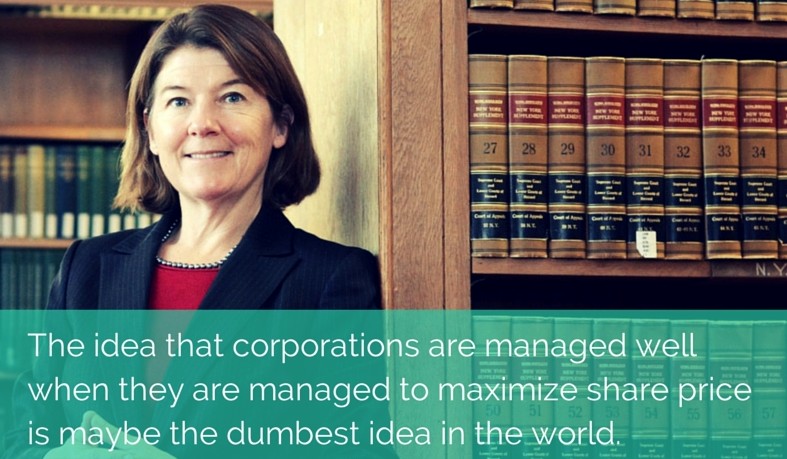
BOOK: The “myth” of shareholder primacy stands at the brink of intellectual failure, Stout writes
Book author Lynn Stout produced The Shareholder Myth in 2012 to challenge the advancement of “shareholder value” as the exclusive guiding principle of corporations.

Lynn Stout’s book Stout, a Cornell Law School professor, debunks the “shareholder myth” by showing how the principle of profit maximization sets corporations on an unsustainable trajectory — detracting from the well being of customers, employees, local communities, and even shareholders themselves. Stout writes that those obsessed with shareholder primacy possess “one fatal flaw” which is “the notion that corporate law requires directors, executives, and employees to maximize shareholder wealth simply isn’t true.”
She adds: “There is no solid legal support for the claim that directors and executives in U.S. public corporations have an enforceable legal duty to maximize shareholder wealth.”
Stout also turns to the empirical record in order to further invalidate the efficacy of the profit-maximizing firm. Stout urges caution in the face of shareholder-supporting proposals by warning of the “remarkable lack of a reliable empirical connection between shareholder-oriented governance practices and better corporate performance at the level of the individual corporation.”
Stout was among participants in a 2013 think-tank session at the Drucker Institute.
Instead of leading to stronger corporate performance, shareholder primacy forces managers into a “myopic” point of view where long term performance is sacrificed in the name of short term shareholder returns. For example, Stout notes the choice to cut research and development costs that fund longer-term growth as common targets of dividend-hungry investors. The result, as Stout writes, is a divergence of interests between shareholders. Investors seeking long-term returns favor corporate decisions that help prepare the company for the long road ahead rather than short-term shareholders who favor immediate and substantial returns from the company. Stout uses the analogy of fishing with dynamite to express the harmful long-term effects of divergent interests among shareholders.
“Conventional shareholder primacy,” according to Stout, “stands on the brink of intellectual failure.” In order to survive, Stout anticipates that “it must evolve into a new, more complex, and more subtle understanding of what shareholders really want from corporations.” By pushing the boundaries of investor consciousness and challenging the restrictively narrow profit-maximizing principle of corporations, Stout’s book represents a powerful critique of shareholder primacy worthy of considerable and sustained attention.
Stout’s book is available on Amazon here
-

CalPERS pension fund includes public interest as central to investing decisions
The changing relationship between corporations and society is at play in the evolving investing strategies of pension funds.

CalPERS CEO Ann Stausboll Rather than electing to exclusively pursue the strongest possible financial returns, some pension funds are investing with other concerns in mind. When CalPERS adopted a set of investment principles Amanda White reported on the announcement. In 2013 California’s largest pension fund published a list of formal investment principles that included an expanded definition of fiduciary responsibilities.
According to CalPERS chief executive Ann Stausboll, “The fiduciary responsibility of pension funds should extend to issues outside the parameters typically understood as being directly related to beneficiaries’ financial interest, says to CalPERS chief executive Ann Stausboll. “It is our job to make sure investors, businesses and policymakers are responding aggressively and creatively to the opportunities associated with climate change and other sustainability issues.”
In step with companies such as Patagonia, CalPERS has emerged as a bold innovator by adopting a more comprehensive view corporate purpose. Patagonia uses “flex hours” in order to enable employees to live active lifestyles. As CalPERS, Patagionia, and other companies continue to broaden their corporate philosophies beyond exclusively serving the interests of shareholders, policymakers also evaluate the existing rules in order to accommodate the changing understanding of corporate purpose.
-

Elizabeth Murdoch: Money not the only “effective measure of all things” or free market “only sorting mechanism”
“As an industry — and indeed as a global society — we have become trapped in our own rhetoric. We need to learn how to be comfortable with articulating purpose and reject the idea that money is the only effective measure of all things or that the free market is the only sorting mechanism.” — Elisabeth Murdoch, executive.
“There is one and only social responsibility of business — to use its resoures and engage in activities designed to increase its profits so long as it stays within the rules of the game, which is to say, engages in open and free competition without deception or fraud.” — Milton Friedman, economist.
Friedman’s line of thinking has informed the beliefs of many of the titans of capitalism who claim that, no matter the negative impacts of their businesses, they are merely playing their part in the capitalist system. Titans such as Rupert Murdoch, the telecommunications giant who is currently #69 on the Forbes Billionaire List with a net worth of $13.8 billion. Murdoch has found himself in the headlines in the past for engaging in questionable practices in the pursuit of profits as his newspapers were investigated for hacking the cellphones of British celebrities, royalty and even regular citizens.
It is instances like this that cause one to challenge Friedman’s concept that the pursuit of profits are businesses only responsibility. However, there are business leaders who offer an alternative to this concept, some of whom come as quite a surprise. One of them is Murdoch’s daughter, Elisabeth, and the CEO of Shine Limited, which stands for more than the pursuit of profits. In 2012, Ms. Murdoch delivered the keynote address at the GuardianMedia Edinburgh International Television Festival and surprised many with the message she sent. Her overall thesis can be best summarized by her quote that, “Profit without purpose is a recipe for disaster.” The speech can be found in it’s entirety here. She said: “As an industry — and indeed as a global society — we have become trapped in our own rhetoric. We need to learn how to be comfortable with articulating purpose and reject the idea that money is the only effective measure of all things or that the free market is the only sorting mechanism.” She added:
“Do we have such faith in the imperatives of the market that we need have no will of our own other than to succeed on its terms? It is increasingly apparent that the absence of purpose — or of a moral language — within government, media or business could become one of the most dangerous own goals for capitalism and freedom.”
It is important to keep in mind that in 2011 Elisabeth sold Shine Limited to her father’s News Corporation. She said the sale was necsary to achieve scale in the increasingly digitized media industry. Murdoch is seen as the possible future head of her father’s empire.
-
BOSTON GLOBE: Is ‘shareholder value’ bad for business?
What is the purpose and structure of the modern corporation, and what are the consequences when management takes a short-term approach to meeting corporate goals?
. In a recent article, Boston Globe reporter Leon Neyfakh captured the debate surrounding the “future of the American corporation—what its purpose is, how it should be run, and whom it should be engineered to benefit.” The article describes how shareholder-guided corporations often fail to adequately serve other stakeholders such as employees, customers, the environment, and local community. Nayfakh also notes the failures of shareholder supremacy and the harms inflicted on others, even shareholders themselves. He writes: “Countless others made short-sighted decisions intended to goose earnings, keep investors happy, and enrich themselves—all without regard for the long-term health of their companies.” Shareholders, according to Neyfakh, have also been harmed by the status quo and are increasingly advocating for greater representation on boards of directors.
There are other strong voices in the debate about the structure and purpose of corporations such as Harvard Law School professor Lucian Bebhuk. He argues that there are significant barriers to greater shareholder activism that stem from the near-absolute power of the board and CEO. Bebchuk favors empowering shareholders to make “rules of the game” decisions about the structure of the corporate ballot set by by-laws. Bebchuk explains that these decisions are unlikely to occur because boards and CEOs accrue private benefits from having control over the corporate ballot such as job security, higher pay, and other perks. This problem of board capture also manifests itself in the exorbitant pay of many CEOs which some have referred to as the “smoking gun” of managerial opportunism and other corporate governance failures.
While the stakeholder model may appear to be a better alternative to the shareholder primacy model, there are unique challenges to detecting and eliminating managerial opportunism under a stakeholder model. If CEO performance is currently quantified in share price and compared to peers, what performance metrics would complement the creation of shareholder value? How would these different metrics be balanced? The inclusion of alternative metrics creates room for CEOs to justify even more egregious pay packages. For example, if a CEO serves the local community and workers well but delivers weak financial results, how much should the CEO be paid? Even under the shareholder model, CEOs are able to justify vast compensation packages to boards and shareholders. During economic downturns, CEOs are paid for performance in spite of various headwinds and obstacles. Insider opportunism is clearly prevalent in the shareholder model and might even be more insidious and frequent in the stakeholder model.
These challenging questions suggest that the stakeholder model might be more vulnerable to insider opportunism than the shareholder model. As Jonathan Macy and Geoffery Miller warn “constituency statutes do not benefit the interests or groups that they ostensibly are intended to benefit. Rather, such statutes benefit a well-organized, highly influential special-interest group, namely the top managers of large, publicly held corporations who wish to terminate the market for corporate control.”
Together, these issues represent an essential point of focus for corporations, politicians, and citizens alike. Accordingly, the Rules Change team will provide coverage on issues of corporate governance as they continue to unfold.