Tag: inequality

  • WHY change the rules? To seek solutions

    Why Change the Rules?


    http://edit.aflcio.org/Corporate-Watch/Paywatch-2014

    Many researchers find that Americans feel the way corporation’s operate is failing us.  Everyone has heard — and many believe — the refrain that America is unequal. We have heard the familiar slogan, “We are the 99%.”  The reality of income inequality in America is staggering.  CEOs earn 331 times as much as the average worker and 774 times as much as those earning minimum wage.[1]  In a 2007 report distributed to across the US, on average people imagined that the average CEO made $500,000, when in reality the number was $14 million.

    This is occurring, in large part, because of the shifting corporate mindset.  Large companies used to focus on stakeholders, taking into account the interest of the employees, shareholders, community, the environment and even the country.  The companies had an eye towards sustainability and long-term profits.  This has shifted to the ubiquitous notion of shareholder value maximization, where solely short-term profits for shareholders matter.  Wealth for the few propagates even more extreme wealth for the even fewer.

    As a result, the middle class is being squeezed, as quality jobs disappear only to be replaced by contingent and retail jobs that simply do not provide enough for the employee.

    America is not working for all of us.  The Rules Change Project aims to spotlight efforts to increase oversight of large public corporations and financial institutions, and watchdog big-money domination of Washington politics.  It serves as an open forum and coalition for those who agree that the rules need to be changed. Our goal is to foster solutions, not point fingers.

    [1] Dill, Kathryn. “Report: CEOs Earn 331 Times As Much As Average Workers, 774 Times As Much As Minimum Wage Earners.” Forbes. Forbes Magazine, 15 Apr. 2015. Web. 07 July 2015.

  • Leo Hindrey — a one time cable and telecom mogul goes to work on the minimum-wage challenge

    Leo Hindery Jr.
    Leo Hindery Jr.

    Leo Hindery is a one-time cable and media mogul and a private-equity fund manager who heads the Smart Globalization Initiative of the New America Foundation.  He writes magazine columns. And, as part of a group called “Smart Capitalists”, he’s also on a tear about the minimum wage.  In 2014, he joined a group of other executives in a visit to Capitol Hill to lobby for an increase in the U.S. federal minimum wage. And in the process, he lobbed pot shots (VIDEO)  at the CEOs of MacDonald’s and Walmart for not giving their workers a raise. “It’ such an ethical issue and it is the right place to start to address the imbalance.”

    MacDonald’s and Walmart have both moved in the right direction since then. But Hindery says the problem is much deeper than just two companies, starting with the way the government measures and reports unemployment. “We have more income inequality in the United States that we’ve had since 1928,” he says.

    While the sheer amount of jobs in the US are growing, by 280,000 in May 2015, the unemployment rate is actually increasing and middle-class workers are finding it harder to make ends meet and earn a living wage. Fundamentally, this is catalyzed by the disappearance of quality manufacturing, blue-collar jobs that have allowed for widespread employment and prosperity. Now, the epicenter of middle-class employment is shifting to corporations, such as WalMart, that value cost cutting and shareholder value above all.

    In mid-2015, the U.S. Bureau of Labor Statistics reports an unemployment rate of 5.5%, up from 5.4% in 2014.

    But those figures fail to address the full scope of the problem of “real employment,” says Hindery, managing partner of InterMedia Partners, a New York-based media industry private equity fund. This is because the number only includes those who have actively searched for work in the past month. There are many who are seeking jobs and have searched for one in the past year but have been too discouraged or somehow hindered from looking during the past month. Hindery estimates there are about 1.9 million “marginally attached workers” as he calls them. Hindery includes part-time-of-necessity workers in his definition of real unemployment, workers who want a full time job but are stuck with fewer working hours than they need. He estimates that there 6.7 million part-time-necessity workers.   Thus he says the real unemployment rate remains steadily at 10.8% from last year to May of this year.

    In large part, this problem occurs because big corporations, such as Walmart, believe that hiring many part time workers and releasing their schedules at the last minute will be the most efficient way to align supply of labor with demand. The more last-minute the schedule, the more accurate the forecast of how many workers are needed, and the less commitment. However, the cost of understaffing can often be higher than overstaffing. Furthermore, the problem of forecasting demand could be largely avoided if there was more investment in employees, such as training employees across many tasks in the company. In this way the task, not the required employee, is what varies depending on demand.

    This approach is in contrast to the “good-jobs strategy” advocated by MIT Sloan School Prof. Zeynep Ton.

    RELATED RESOURCES:

    VIDEO: Hindery, in 2007, talking about then-presidential candidate John Edwards’ economic proposals

  • STUDY: Low-income students in households making less than $28K annually now a majority in the nation’s public schools

    STUDY: Low-income students in households making less than $28K annually now a majority in the nation’s public schools

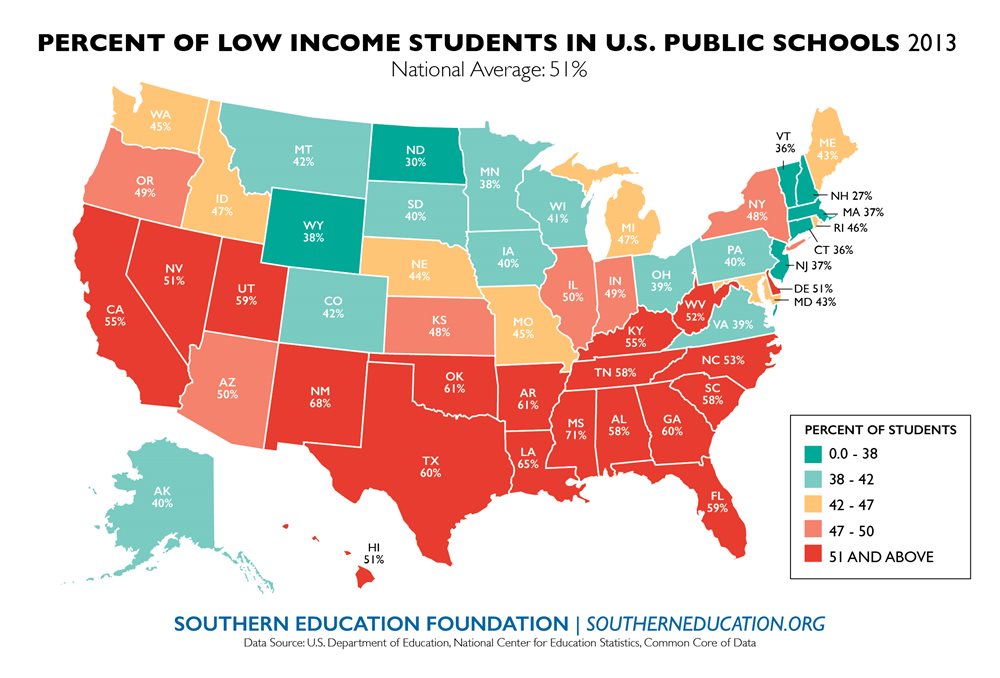
    Low-income students — those living in a single-parent household earning less than $28,000 a year — are now a majority of the schoolchildren attending the nation’s public schools, according to new analysis of state data compiled and analyzed in a January, 2015, report from the Southern Education Research Foundation.  The January, 2015,  report is based on data available from the federal government’s National Center for Education Statistics (NCES). It shows that, as of 2013, 51 percent of the students across the nation’s public schools were low income in 2013.

    “In 40 of the 50 states, low-income students comprised no less than 40 percent of all public schoolchildren. In 21 states, children eligible for free or reduced-price lunches were a majority of the students in 2013,” says a report on the NCES-collected data in the study written by the Southern Education Foundation. 

    A Washington Post article written by Lindsey Layton covered the Southern Education Research Foundation report. Layton wrote: “The shift to a majority-poor student population means that in public schools, a growing number of children start kindergarten already trailing their more privileged peers and rarely, if ever, catch up. They are less likely to have support at home, are less frequently exposed to enriching activities outside of school, and are more likely to drop out and never attend college.”

    Education is portrayed as the most effective weapon in the fight against inequality. The article quotes Darren Walker, the president of the Ford Foundation voicing his concern:

    “Even at 8 or 9 years old, I knew that America wanted me to succeed,” he said. “What we know is that the mobility escalator has simply stopped for some Americans. I was able to ride that mobility escalator in part because there were so many people, and parts of our society, cheering me on . . . we need to fix the escalator. We fix it by recommitting ourselves to the idea of public education. We have the capacity. The question is, do we have the will?”

    What is low income? The SERF report used eligibility for free or reduced lunch to define low income.  The researchers wrote that: “Students are eligible for free meals at public schools if they live in households where the income is no more than 135 percent of the poverty threshold. They are eligible for reduced-price lunches if their household income is no more than 185 percent. In 2013, for example, a student in a household with a single parent with an annual income of less than $19,669 was eligible for a free lunch or less than $27,991 for a reduced-price meal in a public school.”