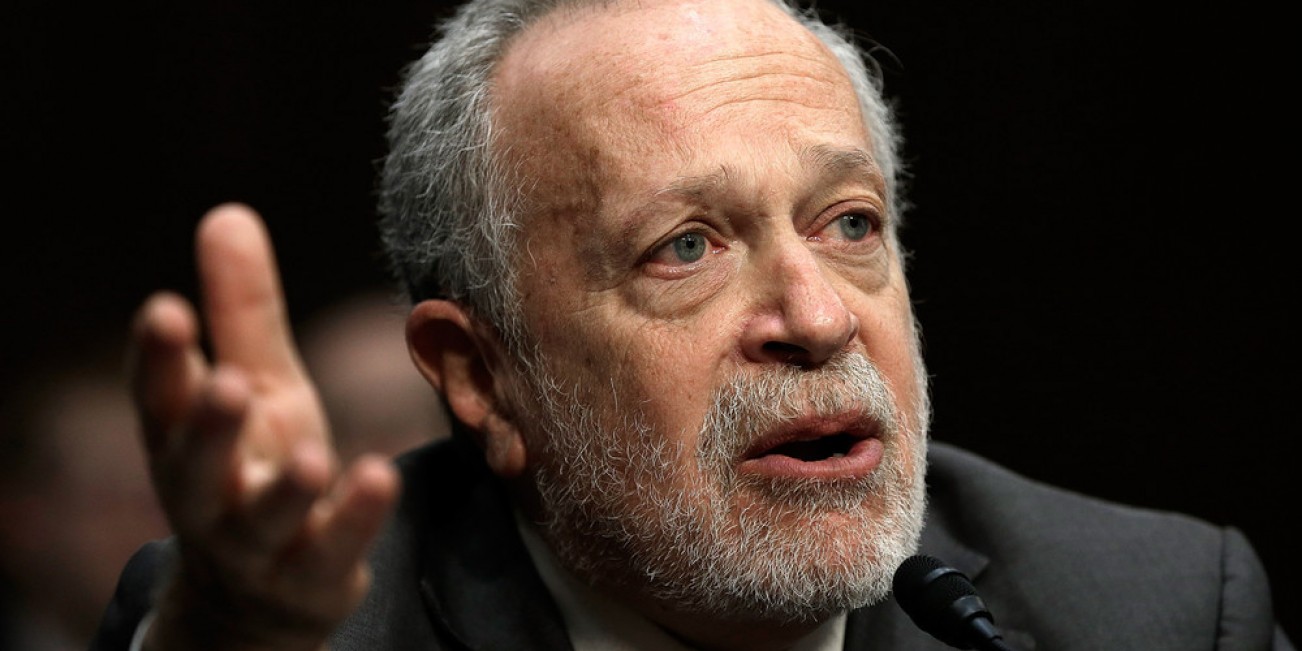
 “Inequality for All, ” a 90-minute documentary featuring former Labor Secretary Robert Reich, is framed within a lecture hall at the University of California Berkeley. Here we see Reich lecturing to 700 students in his “Wealth and Poverty” class.
The filmmakers focus on the real-world financial plight of some of the students in the class,
mixing clips of Reich’s lecturing, with parts of an extended office interview, historical footage of Reich in government service, and graphical charts showing important economic trends.
FILM TRAILER: http://www.youtube.com/watch?v=YCbAyk8aRxI
LEARN MORE: http://inequalityforall.com/
“Many people have a feeling that the game is rigged,” Reich told Democracy Now’s Amy Goodman in an interview broadcast Sept. 13. “But they don’t really understand why, how it’s happened and why it’s dangerous, or what they can do about it. I mean, this film also provides a kind of guide to people. There’s a social-action movement that is connected to the film. So we hope that the film really spurs a—not just a different discussion in this country, but also a movement to take back our economy and democracy.”
“An economy is just a bunch of rules. We can change the rules so that the economy works for more of us not just for a select few,” Reich said in an Oct. 3, interview with Time Magazine.
The central thesis of the documentary, and Reich’s economic views are best set out in his answer to interviewer Joan Brunwasser at OpEdNews.com:
JB: One of the strengths of Inequality for All is the use of animated graphics, for example, the suspension bridge imagery. Can you give some of the facts that the bridge graphic so vividly illustrates?
RR: “ The two peak years for income inequality over the past century were 1928 and 2007 — in which the top 1 percent received over 23 percent of total income. In 1929 and 2008, the economy crashed. Why? Because when so much income is concentrated at the top, the vast middle class (and all those who aspire to join it) simply don’t have the purchasing power to keep the economy going, without them going deep into debt. Eventually those debt bubbles burst (1929 and 2008), and when they do so, the economy goes into deep recession. The only reason the Great Recession wasn’t as deep or as long as the Great Depression was we knew enough to stimulate the economy, and the Fed kept interest rates down. But these were and are only temporary band-aids. The underlying structural problem remains.”
Some other points Reich makes in the film:
- Instead of the “trickle down” economics popularized Republicans and supply-side economists for two decades from the 1980s, Reich coins the phrase “middle-out” economics. He says prosperity can only result when there is a prosperous middle class – because 70 percent of American economic activity results from consumer purchasing, and only a large middle class will purchase enough goods to keep the economy humming. The “great regression” that hollowed out the American middle class started in the 1980s, he says.
- The government “sets the rules by which markets function” and in order to shift to restoring a vibrant middle class, he argues, “the rules governing our markets have to shift as well.” Says Reich to film viewers midway through the documentary: “Remember, we make the rules of the economy, and we have the power to change those rules.”
- Two trends have affected the American economy above all others – globalization and technology. He asks his students at Berkeley – how much of the value in an Apple iPhone manufacturing process benefits American firms? The answer is a single-digit percentage, he says, with the largest chunks of value going to Japan and Germany, where some of the most high-tech parts inside the phone are made. Although the phone is assembled in China, on the low-wage labor costs stay there.
- Amazon Inc. employees about 60,000 workers globally. But the mom-and-pop retailers Amazon has displaced might have employed 10 times that many people to sell the same amount of goods. Such relentless retail efficiency has kept retail prices low, but has also cost millions of jobs.
- In the 1970s, a U.S. meatpacker made $40,000 a year; now they make $24,000 a year.
- Republicans perpetrate a “big lie” that government is always bad.
- Since World War II, wages, productivity rose in lockstep through the 1970s, he argues, and the ratio of average-American wages to income of the rich stayed about the same, Reich argues. Since 1980, productive has continued to rise, wages adjusted for inflation have dropped, and the radio of average-American wages to those of the rich has skyrocketed.
- To cope with having less purchasing power, American middle-class families copied in three ways: (1) Mothers went to work to supplement their husband’s salary then, (2) Both parents started working longer hours, or two jobs and finally, (3) They began borrowing money against their home equity.
- Throughout the film, Reich is heard to make self-deprecating fun of his short stature, which is says results for a genetic trait. He says bullies in school often beat him up, and he learned to connect with older boys as protectors. His life was changed as a young adult, when one of the boys who has protected him in his youth, then a civil rights worker, Michael Schwerner, was brutally tortured and murdered by the Ku Klux Klan in Mississippi in 1964. By then, Reich was working for Atty. Gen. Robert F. Kennedy and, he became determined: “I had to protect the people from the bullies.”
- In the end, he says, “the rich do better when we do better.” The alternative, he says, is a zero sum game where all eventually lose – a shrinking middle class may benefit some wealthy people for some time, but in the end the result is social unrest and a broken economy that will leave everyone poorer. For that reason, he says, “History is on the side of positive social change.”
Of rising inequality, Reich tells interviewer Lizzy Ratner at The Nation: “We fixed it in the 1930s; we made great headway in the ’40s, ’50s and ’60s; but beginning in 1978, we turned our backs on the problem. Mothers flooded into paid work, and we all worked more hours—and then, beginning in the late 1990s, we borrowed against the rising value of our homes. All of those coping mechanisms for maintaining living standards in the face of stagnant or declining wages are now exhausted. So we have no choice but to face reality.”
RELATED LINKS:
http://sandiegofreepress.org/2013/10/another-view-of-robert-reichs-inequality-for-all/
INTERVIEWS:
http://www.democracynow.org/2013/9/13/inequality_for_all_robert_reich_warns
http://newscenter.berkeley.edu/2013/09/27/robert-reich-on-just-released-inequality-for-all-documentary/
http://www.stltoday.com/entertainment/movies/reviews/robert-reich-is-an-appealing-guide-in-documentary-inequality-for/article_822680ba-8ba2-5b97-8a5b-74a18a1b0907.html
http://www.thenation.com/article/176474/robert-reich-his-turn-film-star-inequality-all#