Author: wpdensmore

  • GWO gathering builds knowledge, support for “fourth sector” businesses combining profit, social benefits; sector seen as growing at twice rate of profit-only entities

    GWO gathering builds knowledge, support for “fourth sector” businesses combining profit, social benefits; sector seen as growing at twice rate of profit-only entities

    CONFERENCE NOTES: 
    PART ONE / PART TWO / PART THREE / BACKGROUND

    WASHINGTON, D.C. — Some 200 scholars, public officials, researchers, funders and practitioners — supported by the Federal Reserve Board, George Washington University and others – kicked off an initiative to help prove that capitalists are doing well by doing good – in what they call the “fourth-sector” economy.

    “Mapping the Fourth Sector,” was a one-day, invitation-only brainstorming session (open to media) held Jan. 15, 2015 at the university’s Trachtenberg School of Public Policy organized by a group called the Fourth Sector Network. Other supporters of the gathering included the B Team and the Urban Institute.

    There’s growing recognition of the fourth sector’s potential for delivering solutions to a broad array of social, environmental, and economic challenges,” said retired GWU President Stephen Trachtenberg.   “These include job creation and sustainable economic development to climate change, health care, education, social services, energy and more.”

    The morning featured on-the-record panel presentations with speakers including Don Graves, Deputy Assistant to the President; Kathy Calvin, President and CEO of the UN Foundation; Robert Forrester, Chairman & CEO of Newman’s Own Inc.; Mark Prater, Chief Tax Counsel for the Senate Finance Committee; among others.”

    “Fourth sector” is a term used by some experts to described companies chartered to make a profit at the same time they are pledged to serve one or more social purposes. They are distinct from the three other economic sectors — government, non-profit, and purely profit-making businesses. Organizers want to make sure legal forms and support systems for such organizations are thriving. Well-known examples including Newmans Own Inc.

    “These organizations are creating jobs and their growth rate is almost twice as fast as pure-profit  businesses in the first,” Heerad Sabeti, a Fourth Sector Network co-founder and himself a Raleigh, N.C., entrepreneur, said a few days before the event. “How many are there? That is one thing the mapping initiative is going to tell us — it could be 10% or 20% of GDP already. And they are working to solve social and environmental problems in the process.”

    “As the lines between public, private and nonprofit sectors blur, a fourth sector is emerging that strives to contribute to economic growth while solving social and environmental problems. said Elizabeth T. Boris, a director at the Urban Institute, which was preparing the data map.   “It has the potential for generating immense economic, social and environmental benefits. The mapping project is designed to bring them broader public recognition and engagement.”

    Companies organized in the forth sector are often called “for-benefit” corporations – or “B corps.” They are typically driven to achieve environmental, community, justice or equity goals. They include sustainable businesses, social enterprises, municipal enterprises, community development corporations, social businesses and other models.

    “These efforts are hampered by lack of adequate data and analysis,” says Sabeti.   “Research will help policymakers understand the barriers they face and what would promote their growth and impact.”

    In May 2013, Sabeti’s team staged a gathering at the Harvard Business School called “Growing the Impact Economy.” One outcome was a grant to the Urban Institute to create a systematic method – a “taxonomy” — for categorizing and listing “Fourth Sector” entities. At Thursday’s event, participants will get a preview of the mapping project, which will become public later this year.

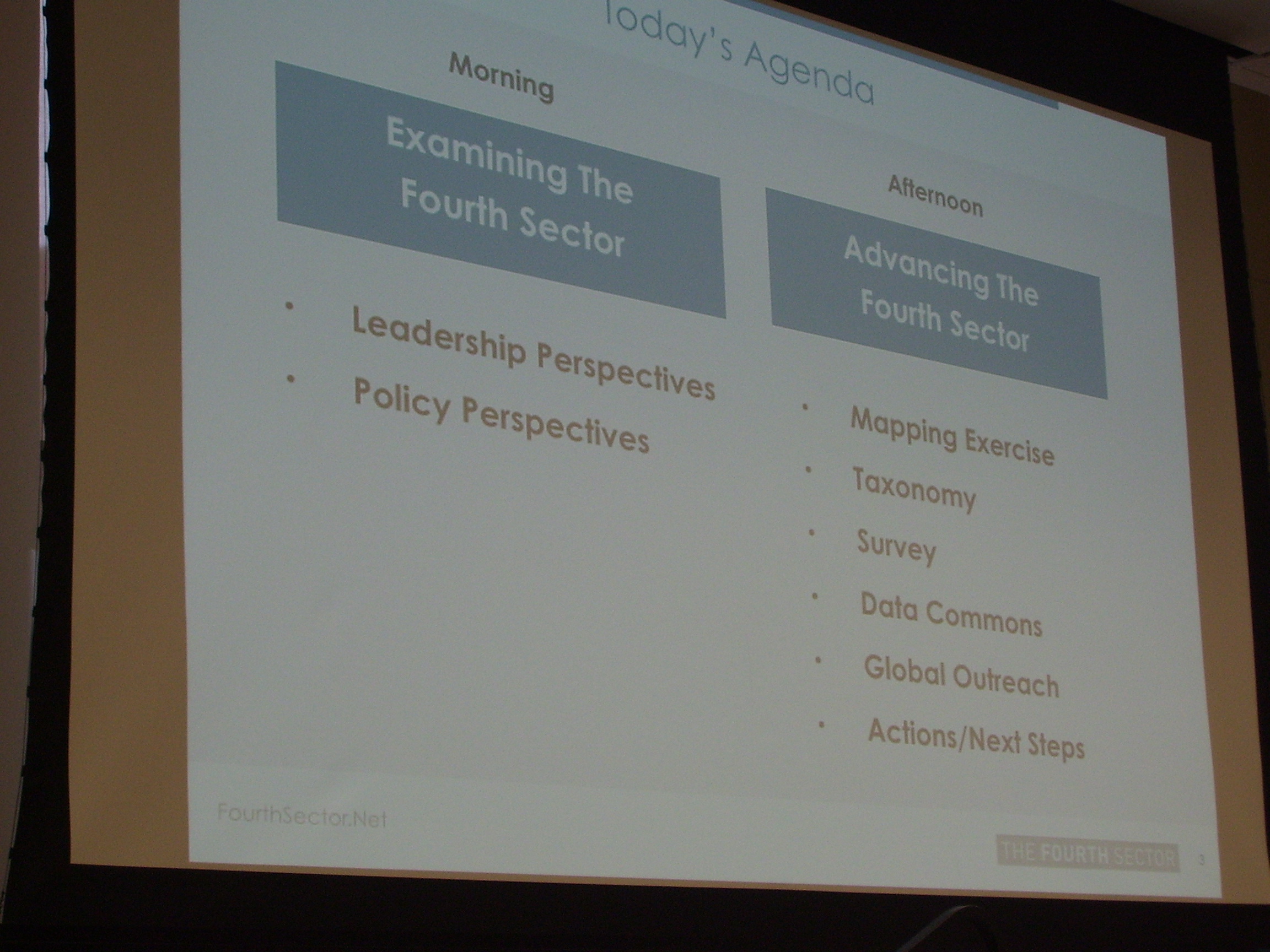
    Following morning session of updates from the speakers, “Mapping the Fourth Sector” participants spent the afternoon in roundtable breakouts, seeking answers to at least four key questions:

    • What distinguishes the Fourth Sector from the private, public and nonprofit sectors? What differentiates various types of for-benefit organizations from each other?
    • How does the Fourth Sector contribute to job and enterprise creation, economic development?
    • What obstacles do for-benefit organizations face and what enabling policies and infrastructure are needed to address them, both regionally and nationally?
    • What can fill the gaps in data and understanding required by public agencies, practitioners, researchers, investors, economic developers and other stakeholders?

    — 30 –

    CONFERENCE NOTES: 
    PART ONE / PART TWO / PART THREE / BACKGROUND

    MEDIA CONTACTS:
    Laura Greenback, Urban Institute, (202) 261-5709, lgreenback@urban.org
    Heerad Sabeti, Fourth Sector Network, 919-426-7722, h.sabeti@forbenefit.net

    EVENT CONVENORS:

    The B Team
    The B Team is a not-for-profit initiative formed by a global group of leaders to create a future where the purpose of business is to be a driving force for social, environmental and economic benefit.

    Federal Reserve Board of Governors
    The Federal Reserve, the central bank of the United States, is a federal system composed of a central governmental agency—the Board of Governors—and 12 regional Federal Reserve Banks. Besides conducting research, analysis, and policymaking related to domestic and international financial and economic matters, the Board plays a major role in the supervision and regulation of U.S. financial institutions and activities, has broad oversight responsibility for the nation’s payments system and the operations and activities of the Federal Reserve Banks, and plays an important role in promoting consumer protection, fair lending, and community development.

    The Urban Institute
    The nonprofit Urban Institute is dedicated to elevating the debate on social and economic policy. For nearly five decades, Urban scholars have conducted research and delivered evidence-based solutions that improve lives, strengthen communities, and increase the effectiveness of public policy. Their objective research helps expand opportunities for all, reduce hardship among the most vulnerable, and strengthen the fiscal health of government across a rapidly urbanizing world.

    Trachtenberg School of Public Policy and Public Administration
    The Trachtenberg School in GWU’s Columbian College of Arts and Sciences is a focal point for public affairs education, research and public service at the George Washington University. Building on a rich tradition of education for public service and on its location in the nation’s capital, just a few blocks west of the White House, the George Washington University offers a superior education for students wishing to pursue public affairs-oriented academic programs.

    RELATED LINKS:

    Story about 2013 conference at Harvard University:
    http://www.csrwire.com/press_releases/35643-Boosting-the-Fourth-sector-Economy-is-Goal-of-200-delegate-Summit-at-Harvard

    Chart: For-Benefit Enterprises and the Fourth Sector:
    http://www.fourthsector.net/learn
    http://www.fourthsector.net/assets/1/fourth-sector_large.jpg

    Read profiles of Fourth Sector businesses:
    http://gamechangers500.com/

    “The Emerging Fourth Sector” (2009 study by The Aspen Institute):
    https://www.aspeninstitute.org/sites/default/files/content/docs/pubs/4th%20sector%20paper%20-%20exec%20summary%20FINAL.pdf

    Report of a 2008 meeting on Fourth Sector legal forms:
    http://www.perlmanandperlman.com/publications/articles/2008/FourthSector.pdf

    IMAGE: Fourth Sector LOGO o
    http://www.ggem-microfinancesl.org/communities/6/004/010/200/376/images/4572993329_pre.jpg

  • GMU assisting project on ideas to change the playing field for corporations, people and democracy

    ARLINGTON, Va. – A multi-partisan spectrum of business, policy and public groups is seeking common ground on changes to the U.S. economic system affecting the regulation and governance of corporations, their impact on consumers, markets, communities and the planet.

    The “Rules Change Project” — at http://www.ruleschange.org — is seeking input from executives, public officials, scholars, researchers, policy activists, students and engaged citizens.

    “It’s time to cross lines, exit silos and listen,” says Bill Densmore, an ex-journalist and researcher who is one of the project organizers. “We want to look at how government and business can collaborate to meet the needs of all stakeholders – employees, customers, citizens, communities and the environment – not just stockholders.” The project aims to bring together silos of thought in a reflective, collaborative, national timeout for corporations, citizens and democracy. It’s designed to assess two decades of mainstream thought on corporate regulation, governance and global-resources impact.

    “Rules Change” is a pioneering national attempt to convene diverse groups working on topics like corporate personhood, money and politics, measurement, accountability and governance that will rethink the game in the public interest, organizers say.

    The project is being assisted by the School of Public Policy at George Mason University and the Media Stewards Project, with advice from the Aspen Institute’s Business & Society Program, the New Economics Coalition (NEI) and the F.B. Heron Foundation..

    “Whether they are worried about the power of government, the power of corporations or diminished public participation in civic affairs, millions of Americans are starting to think the rules of the game need to be reinforced or changed,” says Mark J. Rozell, acting dean of George Mason University’s School of Public Policy.

    Rules Change aims to promote cross-silo knowledge, ideas and collaboration on issues like election reform, corporate personhood, success measures and accountability, money and politics, media responsibility and environmental sustainability. Attendees will look at the rules that govern our economic system – from laws and regulations to consumer behavior, participatory government, corporate governance and more.

    “The idea is to pause and collaboratively and consider feasible changes in the rules of the game that promote the public interest,” says John Boyer, a former professor and TV documentary producer who is among organizers of the gathering. “How are we going to get America working better for all of us?”

    One effort championed by the Rules Change Project is The Civic Stewardship Mapping Project, a multimedia effort to document for the public dozens of groups working on rules-change initiatives. “It will be a navigational tool for concerned citizens to find out where and how they can do something,” says Marcy Murninghan, mapping-project coordinator.

    Rules Change is organized around five “rules-change categories” highlighting policy agendas of diverse groups that share the goal of a more just and sustainability society, says Densmore, Rules Change Project coordinator. “Those categories include influence, measurement, ownership, accountability and governance,” says Densmore. “We want to create a time-out space for partisans across the playing field to find common ground on rules — rather than face ongoing gridlock and perceived unfairness in the game.”

    The Rules Change Project seeks input from individuals and groups working on topics such as:

    • Non-partisan redistricting
    • Changes in a “too-big-to-fail” banking system
    • Corporate governance and sustainability
    • Alternate success indicators besides GNP
    • Reducing or revealing the influence of money on Washington
    • Economic policies to rebuild a middle class

    The rules of American capitalism have evolved from a shared circle of prosperity,” says John Boyer, an event co-organizer and co-founder of the Media Stewards Project. “Business and government leaders once saw four key stakeholders — communities, employees, the environment and customers — as team members along with stockholders. That’s less and less true. America’s economy cannot fairly go on the way it has. It’s time to see if rules change – policy, marketplace, social, ethical — can restore balance among all five stakeholders.”

    ADDITIONAL RESOURCES:

    For additional information contact:

    Bill Densmore, (617-448-6600) / wpdensmore@gmail.com or John Boyer, Co-Founder, Media Stewards Project (703-980-3337) / john@mediastewards.org

  • Rules Change collaborator’s research helping corporations to see “materiality” of environmental, social metrics

    Rules Change collaborator’s research helping corporations to see “materiality” of environmental, social metrics

    Marcy Murninghan

    How to get the world’s corporations to broaden the idea of what is “material” to their business success and responsibility is the the subject of a new paper by Rules Change collaborator Marcy Murninghan. “Redefining Materiality II: Why it Matters, Who’s Involved and What it Means for Corporate Leaders and Boards,” was released Aug. 8 by the international non-profit, AccountAbility.

    Murninghan is co-founder/editor of The Murninghan Post.

    “The boundaries between corporations, the environment, and society continue to blur,” said Ted Grant, global-research head at AccountAbility. “This blurring has made identifying and focusing on what is truly important to long-term company performance, impact, and sustainability even more critical as a governance and management discipline.”

    READ THE FULL REPORT (pdf).

    On September 5, 2013, at 11:00am EDT, AccountAbility will host a webinar with report author Murninghan,  Grant, and private-sector representatives. The discussion will focus on current developments in sustainability and materiality and their implications for private-sector institutions.

  • Aspen, Brookings, Drucker working behind-the-scenes to push executives to reinvent American-style capitalism

    Aspen, Brookings, Drucker working behind-the-scenes to push executives to reinvent American-style capitalism

    The logo of the Aspen program which co-convened the Jan. 10 roundtable.
    The logo of the Aspen program which co-convened the Jan. 10 roundtable.

    In boardrooms and think tanks, private efforts are brewing – largely behind-the-scenes at this point — to bring America’s corporate leaders to the realization that they must help reinvent American capitalism, or risk losing its star role on the world stage — if not its outright collapse.

    Two of the nation’s most prestigious policy think tanks, the Aspen Institute and the Brookings Institute, are collaborating and are joined at least conceptually by the Drucker Institute, named after Peter F. Drucker, one of the world’s most revered, innovative and prolific management theorists.

    “American capitalism is falling short of the aspirations of many of the system’s participants,” declared the agenda for an Aspen-Brookings gathering of 20 corporate leaders held Jan. 10 in a private, 10th-floor Madison Avenue boardroom.  “Historically, the United States has responded to periods of dissatisfaction with business and capitalism with innovative vigor buttressed by sensible policy to address the deepest concerns with the system.”

    For a half day, high-level executives in banking, finance, consumer products, advertising, accounting and fund management considered corporate purpose, investment advocacy and tax policies seeking an answer to this question: “Where might few find common ground in the current political environment?”

    New generation employee drivers?

    Steven Pearlstein, among participants in Rules Change: The DC Gathering at George Mason University.
    Steven Pearlstein, among participants in Rules Change: The DC Gathering at George Mason University.

    Brookings made public a white-paper by Steven Pearlstein, Pulitzer Prize-winning economics columnist for The Washington Post, in conjunction with the Jan. 10 gathering, entitled: “Social Capital, Corporate Purpose and the Revival of American Capitalism.” Pearlstein was among participants.  A key conclusion of his 22-page paper: A new generation of younger employee-managers will push corporations away from the “straighjacket of shareholder value” because they will only stay with workplaces that offer “meaning and social value.” (DOWNLOAD PAPER)

    In the end, roundtable participants adjourned having kicked around multiple concrete ideas, but without explicitly seeking consensus on the question which began their meeting: “What problems are we trying to solve in corporate governance reform?”   However, organizers  pledged that the meeting was the first of several planned.

    “Chatham House Rule”

    The basis for the roundtable discussion was the “Chatham House Rule” — No public quotation of individuals by name without their permission, a rule made in hopes of promoting uninhibited dialogue.  Social-media tweeting was permitted. “How can we restore public confidence in business?” tweeted Elaine C. Kamarck, director of the Brookings Center for Effective Policy Management, a Harvard Kennedy School lecturer, and a co-convenor of the Madison Avenue gathering.

    One participant wondered: Is a 50-year-trend toward a single-minded boardroom focus on increasing short-term stock price, so-called “shareholder capitalism” the reason why the public in polls has the lowest-ever respect for American corporations? Declared another participant: “If business doesn’t take the lead, this country is going to be harmed and disadvantaged.” A third asked: “How can we design policies that enhance America’s global competitiveness?”

    “What policies can help reduce incentives for short-termism and corporate tax avoidance,” tweeted Judith F. Samuelson, head of Aspen’s Business & Society Program, who co-convened and lead the discussion.  Asked another participant: “How do we give corporations the flexibility & incentives to do the right thing over the long-term?”

    The idea of curbing management for the short term is advanced by the Drucker Institute, which held its own invitation-only gathering at Claremont Graduate Institute near Los Angeles in September, 2013.  Yet: “The term ‘short-termism’ has never come up in government,” said one participant who formerly worked in the U.S. White House. “Corporate governance comes up on the periphere.”

    One manifestation of “short termism” is profits generated by passing environmental or social costs on to others, said one summit participant.  This undermines capitalism’s moral high ground and erodes faith in the system, the participant added.

    Among ideas discussed by the Aspen-Brookings group:

    • Whatever consensus can be developed within corporate America for change should be documented and “socialized more broadly.”
    • Focus on policy changes that will modify the behavior of corporate managers, in part through a tax system which encourages good behavior and discourages bad behavior. “Is there a fiduciary duty of Apple to reduce their tax to zero?” asked one participant.
    • Adopt a more uniform approach to taxing stock trading across all Organization for Economic Co-operation and Development (http://www.oecd.org ) countries, as a way of raising revenue and discouraging “in-and-out” trading.  One participant said the U.S. Treasury Department continues to oppose this, and asked why?
    • Adjust the influence of institutional fund managers on boardroom decision-making by forcing them to vote and conduct shareholder advocacy from the perspective of their long-term retirement-savings investors rather than the short-term earnings incentives of the fund managers themselves. “What policies can help elevate the interests of the end investor above the short-term interests of intermediaries?” asked one participant.
    • Develop a information resource which measures and publicizes corporate performance using “total return to society” metrics much like a food nutritional label, and which also judges the performance of fund managers in the same way. “Have we done the work of putting measurement of corporate governance and performance in a little box and posting it?” asked one participant.
    • Require public corporations to include a concise, uniform statement of their mission in each annual report, a statement of the metrics they are using the measure its achievement, and how their mission is affecting multiple stakeholders, such as employees, customers, communities and the environment – in addition to stockholders and executives. This could be used by investors to pick-and-choose on an apples-to-apples basis investment in companies based on their total returns to society and operational strategies.
    • Develop public “stewardship codes” for fund managers and a “governance codes” for executive boards and managers.  This could help individual investors to make decisions about where to put their money.
    Stephen Davis, Harvard Law / Brookings corporate governance expert
    Stephen Davis, Harvard Law / Brookings corporate governance expert

    Roundtable participant Stephen Davis, of the Program on Corporate Governance at Harvard Law School, cited his own 2012 Brookings paper noting there is no single federal regulator for protecting the retirement savings investments of American workers. “Who should mind the industry? Oversight of long-term savings has become a regulatory orphan,” he wrote in 2012.

    A prevailing theme at the Aspen-Brookings gathering was the role and impact of activist investors on turning the attention of corporate CEOs to inflating stock prices rather than managing for the long term.

    “Companies should say how they are run and for what purposes they are run and should be held accountable for it,” said one participant. Companies who do so forthrightly aren’t as  likely to be takeover targets, the participant added.  “Nobody messes with people like Warren Buffett or Steve Jobs.”

    On taxes, one tax-policy expert declared: “We heed more tax revenues – we have a revenue problem not a spending problem.”  Much discussion centered on the impact of raising the U.S. tax on capital gains, extending the holding period to three years or more for capital-gains treatment, or eliminating completely the distinction between capital-gains and ordinary income or retained earnings.  There was no obvious consensus, however.

    RELATED LINKS


    • “Long-Term Value Creation: Guiding Principles for Corporations and Investors,” an Aspen report: http://t.co/NJhObfLChv“Darden’s dilemma shows us bitter truths about boardroom behavior,” by Steven Pearstein, the Washington Post, Jan. 2, 2014. http://t.co/rjXsw1KiJO
  • Drucker Institute mulls starting “long-termism movement; seeks guidance on whether to participate in forum on topic

    Drucker Institute mulls starting “long-termism movement; seeks guidance on whether to participate in forum on topic

    shareholder-myth-wide
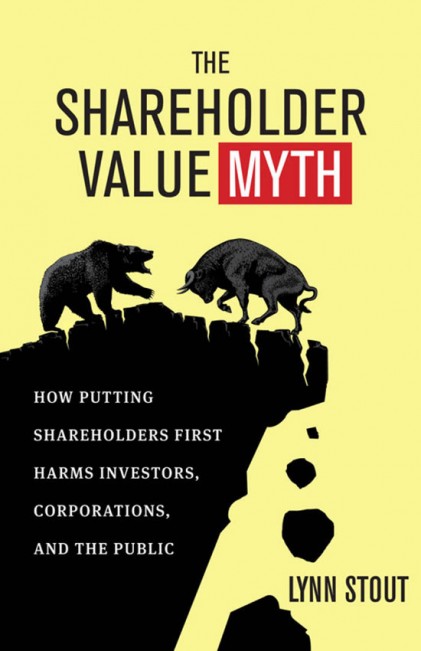
    Lynn Stout’s 2012 book

    A common view of economic theorists and political activists is that public companies respond to pressure for ever-rising quarterly earnings with management decisions that underweight the corporation’s impact on long-term values like ecological stewardship, ethics, or social equity.

    Now a California-based think tank inspired by one of the greatest management theorists of the 20th century is seeking to change the situation.  The Drucker Institute at Claremont Graduate Institute,  near Los Angeles, began a “We’re in It for the Long-Term,” campaign with a September, 2013 gathering.

    Sixteen participants in a two-day gathering at Drucker discussed how to encourage more long-term thinking in the corporate community. You can hear some of their thinking in a “Drucker on the Dial” podcast.

    “Our agenda was threefold: to learn what each other is doing to counter corporate myopia,” writes project leader Rick Wartzman, Drucker’s executive director, and a former journalist. “To see where we might be able to form natural alliances and support each other’s work, and to determine whether our various actions might somehow add up into a larger movement.”

    Now the group is considering whether to continue to pursue a long-termism movement, especially through changes in the way business schools teach decision theory. For example, is the decades-old mantra – “the purpose of a corporation is to maximize shareholder value” – still unchallengeable?

    Lynn StoutOne of the participants in the September gathering, Cornell University law professor Lynn Stout thinks not. Her book, “The Shareholder Value Myth,” argues there are at least three other corporate stakeholders – employees, communities and customers  — who should be given major if not equal consideration.   (VIDEO)

    Drucker, in dozens of books through his lifetime, was a master of  pithy advice for the corporate managers.  In a series of web-site “knowledge nuggets,” begun since the September gathering, the Drucker Institute is offering some of his best, along with current intelligence in similar form.

    These two “nuggets” buttress Stout’s book argument:

    “The ultimate irony may be that the allegiance to shareholder value has caused the very problem it was intended to cure: enriching senior executives at the shareholders’ expense.” —Mark Kramer, Managing Director of FSG

    “There’s a growing body of evidence that the companies that are most successful at maximizing shareholder value over time are those that aim toward goals other than maximizing shareholder value.”

  • Can “The Age of Empathy” help us achieve rules change?

    Can “The Age of Empathy” help us achieve rules change?

    British-based philosopher and sociologist Roman Krznaric advises Oxfam and the United Nations on the nature of “empathy,” and in a blog-essay “Six Habits of Highly Empathetic People” he provides some possible insight on how we might bring silos of thought together to achieve rules change that help the U.S. economy, government and business work better for all of us.

    He says challenging prejudices and discovering commonalities is an important way of overcoming hatred and changing minds. So is making an attempt to appreciate or live within the experience of others. We need to empathize with people whose believes we don’t share or who may be enemies in some way, write Krznaric, who is on the faculty of London’s “School of Life.”

    “The 21st century should become the Age of Empathy,” he writes. “When we discover ourselves not simply through self-reflection, but by becoming interested in the lives of others. We need empathy to create a new kind of revolution. Not an old-fashioned revolution built on new laws, institutions, or policies, but a radical revolution in human relationships.”

    Krznaric’s forthcoming book (February 6, 2014) is called, “Empathy: A Handbook for Revolution.”

  • Politically independent college students favor structural reforms to reduce partisanship, N.C. poll finds

    Politically independent college students favor structural reforms to reduce partisanship, N.C. poll finds

    If the opinions of a sample of U.S. college students are to be trusted, American politics will need to become decidedly less partisan in the decades ahead.   That’s according to research undertaken by Omar H. Ali, a University of North Carolina-Greensboro professor.

    Omar Ali, Ph.D.
    Omar Ali, Ph.D.

    Ali polled 1,246 college students at 16 North Carolina campuses over two months who self-identified as neither Democrat nor Republican and asked them 21 questions. “A plurality of college students self-identify as independent regardless of how they are registered to vote,” says Ali. Nearly two-thirds expressed being anti-party and said they don’t want to be labeled as partisan.

    “College independents say they strongly favor structural political reforms that would reduce partisanship in the political process,” Ali also wrote in an analysis of his research, adding: “The overall results suggest the emergency of a non-partisan politics among younger voters.”

    The survey was conducted over eight weeks from September through November 2012.

    The survey report, released in August, can be downloaded from HERE. 

  • RC-DC will feature responsible ‘hackathon’ to gather corporate social and environmental performance data

    RC-DC will feature responsible ‘hackathon’ to gather corporate social and environmental performance data

    context_reportingA new effort to make open — and free to the public — environmental, social and governance records of U.S. and global corporations will launch at Rules Change-The DC Gathering.

    bill-baue-HEAD-new
    Bill Baue

    “Companies are disclosing more and more information about their social and environmental performance,” says Bill Baue, an Amherst, Mass.-based corporate sustainability engagement consultant, who is running the project, called “ContextReporting.com” with co-founder Tom O’Malley. “But this data deluge is locked in individual pdf reports, creating a big logjam for activists and the public being able scrutinize and compare sustainability impacts among companies.”

    Baue says Rules Change-The DC Gathering will feature a ‘hackathon’ to begin crowdsourcing data-gathering to upload into the ContextReporting online platform. it enables year-to-year and company-to-company benchmarking as a means of holding companies accountable.

    Baue says there are several high-priced sources of data about how corporations are performing on social- and environmental-progress indicators – such things as toxic and greenhouse-gas emissions or wages and working conditions.  But there is no free, open source for that data.

    Baue says ContextReporting will initially allow users to compare Environmental, Social and Governance (ESG) data across industries within seconds, for free. Eventually, he hopes the site will add collaboration tools for users

    ContextReporting.com has been trialing the idea in pharmaceuticals, computers and peripherals and semiconductors, in a unique partnership with the graduate student at Saint Lous University’s Center for Sustainability, Stephanie L. Simowski.  During fall, 2013, Simowski gave a group of fellow students 10 hyours of training on how to gather corporate sustainability data, says Baue. Then each student earned credit by spending 90 hours gathering such information.  Their data-collection on the three sectors is up to 100 companies.

    Now, says Baue, it’s time to figure out how to crowd-source the data collection, then fund careful sifting and checking of the data before it is put online publicly.  A New York-based non-profit research firm, The Governance & Accountability Institute, has tracked the data. But until Baue and O’Malley emerged with ContextReporting, there wasn’t an approach to putting it into a free, public database.

    “At Rules Change, we plan basically a [socially-responsible] hackathon on Saturday and Sunday, March 15-16, where we’ll collect and look at the data, and then do some real-time quality-assurance work on it,” says Baue.  He hopes that NetImpact members will be among those helping.

    “Companies complain that nobody reads the sustainability reports and websites they spend so much time and expense preparing,” says Baue. “And stakeholders who rely on this information from companies bemoan the increasing barrage of data that lacks the necessary context to assess its relevance and validity. “

    Enter ContextReporting, a free sustainability data visualization and benchmarking app, to fill this gap.  It’s  designed around Global Reporting Initiative indicators in the environmental, social and governance (ESG) realms. So you can dive deep into key performance indicators (KPIs) such as total water use (E), product responsibility and human rights (S), and board structure (G).

    Let’s say, for example, you’re wondering about the carbon emissions of the semiconductor industry. Just click the first listed profile, Advanced Micro Devices, then under “Emissions Reduction” click “Total CO2 Equivalent Emissions,” and Voilà! — up pops a chart of performance from 2007 to 2010, showing AMD’s emissions going way up in 2008, then back down through 2010.

    The Global Reporting Initiative writes on its website that “an awareness and uptake of sustainability reporting has increased dramatically in recent years. Many organizations consider sustainability reporting to be necessary and beneficial. But growth in sustainability reporting needs to be exponential for it to become a standard business activity.” o make sustainability reporting standard practice, GRI is:

    For more information or to help with the sustainability-reporting project, contact Baue by email at bbaue@verizon.net.