Category: Uncategorized

  • Drucker Institute mulls starting “long-termism movement; seeks guidance on whether to participate in forum on topic

    Drucker Institute mulls starting “long-termism movement; seeks guidance on whether to participate in forum on topic

    shareholder-myth-wide
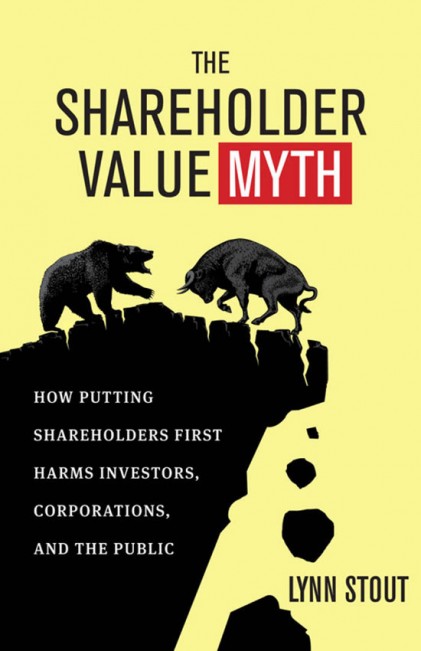
    Lynn Stout’s 2012 book

    A common view of economic theorists and political activists is that public companies respond to pressure for ever-rising quarterly earnings with management decisions that underweight the corporation’s impact on long-term values like ecological stewardship, ethics, or social equity.

    Now a California-based think tank inspired by one of the greatest management theorists of the 20th century is seeking to change the situation.  The Drucker Institute at Claremont Graduate Institute,  near Los Angeles, began a “We’re in It for the Long-Term,” campaign with a September, 2013 gathering.

    Sixteen participants in a two-day gathering at Drucker discussed how to encourage more long-term thinking in the corporate community. You can hear some of their thinking in a “Drucker on the Dial” podcast.

    “Our agenda was threefold: to learn what each other is doing to counter corporate myopia,” writes project leader Rick Wartzman, Drucker’s executive director, and a former journalist. “To see where we might be able to form natural alliances and support each other’s work, and to determine whether our various actions might somehow add up into a larger movement.”

    Now the group is considering whether to continue to pursue a long-termism movement, especially through changes in the way business schools teach decision theory. For example, is the decades-old mantra – “the purpose of a corporation is to maximize shareholder value” – still unchallengeable?

    Lynn StoutOne of the participants in the September gathering, Cornell University law professor Lynn Stout thinks not. Her book, “The Shareholder Value Myth,” argues there are at least three other corporate stakeholders – employees, communities and customers  — who should be given major if not equal consideration.   (VIDEO)

    Drucker, in dozens of books through his lifetime, was a master of  pithy advice for the corporate managers.  In a series of web-site “knowledge nuggets,” begun since the September gathering, the Drucker Institute is offering some of his best, along with current intelligence in similar form.

    These two “nuggets” buttress Stout’s book argument:

    “The ultimate irony may be that the allegiance to shareholder value has caused the very problem it was intended to cure: enriching senior executives at the shareholders’ expense.” —Mark Kramer, Managing Director of FSG

    “There’s a growing body of evidence that the companies that are most successful at maximizing shareholder value over time are those that aim toward goals other than maximizing shareholder value.”

  • Can “The Age of Empathy” help us achieve rules change?

    Can “The Age of Empathy” help us achieve rules change?

    British-based philosopher and sociologist Roman Krznaric advises Oxfam and the United Nations on the nature of “empathy,” and in a blog-essay “Six Habits of Highly Empathetic People” he provides some possible insight on how we might bring silos of thought together to achieve rules change that help the U.S. economy, government and business work better for all of us.

    He says challenging prejudices and discovering commonalities is an important way of overcoming hatred and changing minds. So is making an attempt to appreciate or live within the experience of others. We need to empathize with people whose believes we don’t share or who may be enemies in some way, write Krznaric, who is on the faculty of London’s “School of Life.”

    “The 21st century should become the Age of Empathy,” he writes. “When we discover ourselves not simply through self-reflection, but by becoming interested in the lives of others. We need empathy to create a new kind of revolution. Not an old-fashioned revolution built on new laws, institutions, or policies, but a radical revolution in human relationships.”

    Krznaric’s forthcoming book (February 6, 2014) is called, “Empathy: A Handbook for Revolution.”

  • Politically independent college students favor structural reforms to reduce partisanship, N.C. poll finds

    Politically independent college students favor structural reforms to reduce partisanship, N.C. poll finds

    If the opinions of a sample of U.S. college students are to be trusted, American politics will need to become decidedly less partisan in the decades ahead.   That’s according to research undertaken by Omar H. Ali, a University of North Carolina-Greensboro professor.

    Omar Ali, Ph.D.
    Omar Ali, Ph.D.

    Ali polled 1,246 college students at 16 North Carolina campuses over two months who self-identified as neither Democrat nor Republican and asked them 21 questions. “A plurality of college students self-identify as independent regardless of how they are registered to vote,” says Ali. Nearly two-thirds expressed being anti-party and said they don’t want to be labeled as partisan.

    “College independents say they strongly favor structural political reforms that would reduce partisanship in the political process,” Ali also wrote in an analysis of his research, adding: “The overall results suggest the emergency of a non-partisan politics among younger voters.”

    The survey was conducted over eight weeks from September through November 2012.

    The survey report, released in August, can be downloaded from HERE. 

  • RC-DC will feature responsible ‘hackathon’ to gather corporate social and environmental performance data

    RC-DC will feature responsible ‘hackathon’ to gather corporate social and environmental performance data

    context_reportingA new effort to make open — and free to the public — environmental, social and governance records of U.S. and global corporations will launch at Rules Change-The DC Gathering.

    bill-baue-HEAD-new
    Bill Baue

    “Companies are disclosing more and more information about their social and environmental performance,” says Bill Baue, an Amherst, Mass.-based corporate sustainability engagement consultant, who is running the project, called “ContextReporting.com” with co-founder Tom O’Malley. “But this data deluge is locked in individual pdf reports, creating a big logjam for activists and the public being able scrutinize and compare sustainability impacts among companies.”

    Baue says Rules Change-The DC Gathering will feature a ‘hackathon’ to begin crowdsourcing data-gathering to upload into the ContextReporting online platform. it enables year-to-year and company-to-company benchmarking as a means of holding companies accountable.

    Baue says there are several high-priced sources of data about how corporations are performing on social- and environmental-progress indicators – such things as toxic and greenhouse-gas emissions or wages and working conditions.  But there is no free, open source for that data.

    Baue says ContextReporting will initially allow users to compare Environmental, Social and Governance (ESG) data across industries within seconds, for free. Eventually, he hopes the site will add collaboration tools for users

    ContextReporting.com has been trialing the idea in pharmaceuticals, computers and peripherals and semiconductors, in a unique partnership with the graduate student at Saint Lous University’s Center for Sustainability, Stephanie L. Simowski.  During fall, 2013, Simowski gave a group of fellow students 10 hyours of training on how to gather corporate sustainability data, says Baue. Then each student earned credit by spending 90 hours gathering such information.  Their data-collection on the three sectors is up to 100 companies.

    Now, says Baue, it’s time to figure out how to crowd-source the data collection, then fund careful sifting and checking of the data before it is put online publicly.  A New York-based non-profit research firm, The Governance & Accountability Institute, has tracked the data. But until Baue and O’Malley emerged with ContextReporting, there wasn’t an approach to putting it into a free, public database.

    “At Rules Change, we plan basically a [socially-responsible] hackathon on Saturday and Sunday, March 15-16, where we’ll collect and look at the data, and then do some real-time quality-assurance work on it,” says Baue.  He hopes that NetImpact members will be among those helping.

    “Companies complain that nobody reads the sustainability reports and websites they spend so much time and expense preparing,” says Baue. “And stakeholders who rely on this information from companies bemoan the increasing barrage of data that lacks the necessary context to assess its relevance and validity. “

    Enter ContextReporting, a free sustainability data visualization and benchmarking app, to fill this gap.  It’s  designed around Global Reporting Initiative indicators in the environmental, social and governance (ESG) realms. So you can dive deep into key performance indicators (KPIs) such as total water use (E), product responsibility and human rights (S), and board structure (G).

    Let’s say, for example, you’re wondering about the carbon emissions of the semiconductor industry. Just click the first listed profile, Advanced Micro Devices, then under “Emissions Reduction” click “Total CO2 Equivalent Emissions,” and Voilà! — up pops a chart of performance from 2007 to 2010, showing AMD’s emissions going way up in 2008, then back down through 2010.

    The Global Reporting Initiative writes on its website that “an awareness and uptake of sustainability reporting has increased dramatically in recent years. Many organizations consider sustainability reporting to be necessary and beneficial. But growth in sustainability reporting needs to be exponential for it to become a standard business activity.” o make sustainability reporting standard practice, GRI is:

    For more information or to help with the sustainability-reporting project, contact Baue by email at bbaue@verizon.net.

  • We can change the rules of the economy, Robert Reich says in documentary “Inequality for All”

    We can change the rules of the economy, Robert Reich says in documentary “Inequality for All”

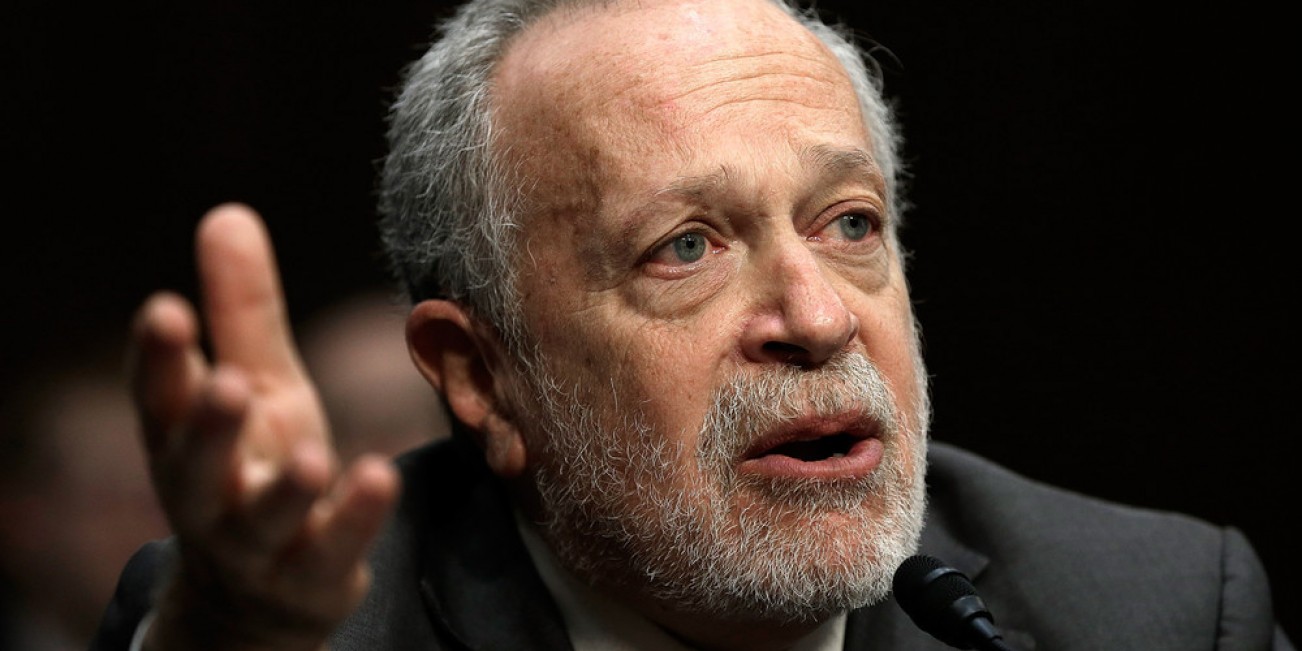
    robert-reich“Inequality for All, ” a 90-minute  documentary featuring former Labor Secretary Robert Reich, is framed within a lecture hall at the University of California Berkeley. Here we see Reich lecturing to 700 students in his “Wealth and Poverty” class.

    The filmmakers focus on the real-world financial plight of some of the students in the class,
    mixing clips of Reich’s lecturing, with parts of an extended office interview, historical footage of Reich in government service, and graphical charts showing important economic trends.

    FILM TRAILER: http://www.youtube.com/watch?v=YCbAyk8aRxI
    LEARN MORE: http://inequalityforall.com/

    “Many people have a feeling that the game is rigged,” Reich told Democracy Now’s Amy Goodman in an interview broadcast Sept. 13. “But they don’t really understand why, how it’s happened and why it’s dangerous, or what they can do about it. I mean, this film also provides a kind of guide to people. There’s a social-action movement that is connected to the film. So we hope that the film really spurs a—not just a different discussion in this country, but also a movement to take back our economy and democracy.”

    “An economy is just a bunch of rules. We can change the rules so that the economy works for more of us not just for a select few,” Reich said in an Oct. 3, interview with Time Magazine.

    The central thesis of the documentary, and Reich’s economic views are best set out in his answer to interviewer Joan Brunwasser at OpEdNews.com:

    JB: One of the strengths of Inequality for All is the use of animated graphics, for example, the suspension bridge imagery. Can you give some of the facts that the bridge graphic so vividly illustrates?

    RR: “ The two peak years for income inequality over the past century were 1928 and 2007 — in which the top 1 percent received over 23 percent of total income. In 1929 and 2008, the economy crashed. Why? Because when so much income is concentrated at the top, the vast middle class (and all those who aspire to join it) simply don’t have the purchasing power to keep the economy going, without them going deep into debt. Eventually those debt bubbles burst (1929 and 2008), and when they do so, the economy goes into deep recession. The only reason the Great Recession wasn’t as deep or as long as the Great Depression was we knew enough to stimulate the economy, and the Fed kept interest rates down. But these were and are only temporary band-aids. The underlying structural problem remains.”

    Some other points Reich makes in the film:

    • Instead of the “trickle down” economics popularized Republicans and supply-side economists for two decades from the 1980s, Reich coins the phrase “middle-out” economics. He says prosperity can only result when there is a prosperous middle class – because 70 percent of American economic activity results from consumer purchasing, and only a large middle class will purchase enough goods to keep the economy humming.  The “great regression” that hollowed out the American middle class started in the 1980s, he says.
    • The government “sets the rules by which markets function” and in order to shift to restoring a vibrant middle class, he argues, “the rules governing our markets have to shift as well.”  Says Reich to film viewers midway through the documentary: “Remember, we make the rules of the economy, and we have the power to change those rules.”
    • Two trends have affected the American economy above all others – globalization and technology.  He asks his students at Berkeley – how much of the value in an Apple iPhone manufacturing process benefits American firms? The answer is a single-digit percentage, he says, with the largest chunks of value going to Japan and Germany, where some of the most high-tech parts inside the phone are made. Although the phone is assembled in China, on the low-wage labor costs stay there.
    • Amazon Inc. employees about 60,000 workers globally.  But the mom-and-pop retailers Amazon has displaced might have employed 10 times that many people to sell the same amount of goods. Such relentless retail efficiency has kept retail prices low, but has also cost millions of jobs.
    • In the 1970s, a U.S. meatpacker made $40,000 a year; now they make $24,000 a year.
    • Republicans perpetrate a “big lie” that government is always bad.
    •  Since World War II, wages, productivity rose in lockstep through the 1970s, he argues, and the ratio of average-American wages to income of the rich stayed about the same, Reich argues. Since 1980, productive has continued to rise, wages adjusted for inflation have dropped, and the radio of average-American wages to those of the rich has skyrocketed.
    • To cope with having less purchasing power, American middle-class families copied in three ways: (1) Mothers went to work to supplement their husband’s salary then, (2) Both parents started working longer hours, or two jobs and finally, (3) They began borrowing money against their home equity.
    • Throughout the film, Reich is heard to make self-deprecating fun of his short stature, which is says results for a genetic trait.  He says bullies in school often beat him up, and he learned to connect with older boys as protectors.  His life was changed as a young adult, when one of the boys who has protected him in his youth, then a civil rights worker, Michael Schwerner, was brutally tortured and murdered by the Ku Klux Klan in Mississippi in 1964.  By then, Reich was working for Atty. Gen. Robert F. Kennedy and, he became determined:  “I had to protect the people from the bullies.”
    • In the end, he says, “the rich do better when we do better.”  The alternative, he says, is a zero sum game where all eventually lose – a shrinking middle class may benefit some wealthy people for some time, but in the end the result is social unrest and a broken economy that will leave everyone poorer. For that reason, he says, “History is on the side of positive social change.”

    Of rising inequality, Reich tells interviewer Lizzy Ratner at The Nation: “We fixed it in the 1930s; we made great headway in the ’40s, ’50s and ’60s; but beginning in 1978, we turned our backs on the problem. Mothers flooded into paid work, and we all worked more hours—and then, beginning in the late 1990s, we borrowed against the rising value of our homes. All of those coping mechanisms for maintaining living standards in the face of stagnant or declining wages are now exhausted. So we have no choice but to face reality.”

    RELATED LINKS:
    http://sandiegofreepress.org/2013/10/another-view-of-robert-reichs-inequality-for-all/

    INTERVIEWS:
    http://www.democracynow.org/2013/9/13/inequality_for_all_robert_reich_warns
    http://newscenter.berkeley.edu/2013/09/27/robert-reich-on-just-released-inequality-for-all-documentary/
    http://www.stltoday.com/entertainment/movies/reviews/robert-reich-is-an-appealing-guide-in-documentary-inequality-for/article_822680ba-8ba2-5b97-8a5b-74a18a1b0907.html
    http://www.thenation.com/article/176474/robert-reich-his-turn-film-star-inequality-all#

  • Annie Leonard using “rules change” framing

    Annie Leonard using “rules change” framing

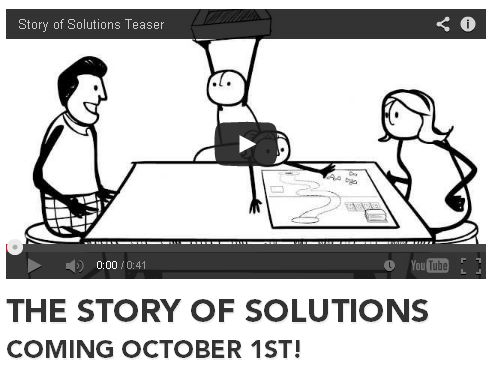
    Annie Leonard, originator of the “Story of Stuff” series of policy videos, is using the “change the rules of the game” frame to describe her latest work.

    Story of Solutions
    Story of Solutions

    “Just like a game, our economy was designed by people to get everybody to play by certain rules and like a game it comes with instructions telling us what the goal is,” Leonard says in a preview of The Story of Solutions, out Oct. 1. “And that goal is more.”

    She adds: “Five years ago, when we made The Story of Stuff we started building a community of people who sensed that something was really wrong with this old game. We agreed there was a problem. Now it’s time to build the solutions. Solutions that won’t just change a few of the rules, but will change the entire game.”

  • What is the Rules Change Project?

    What is the Rules Change Project?

    The Rules Change Project is an initiative to support action ideas for capitalism and the common good. America is not working for all of us. The Rules Change Project is an open coalition to spotlight, amplify and support existing efforts at economic “rules change.” It is an informal, non-partisan collaboration of individuals and independent groups seeking to help launch a national conversation.


    THE RULES CHANGE PROJECT: WHY NOW?

     The Rules Change Project is an initiative to support action ideas for capitalism and the common good. It began with a small leadership summit at UMass Amherst in May, 2013: “Rules Change: Resetting the Playing Field for Corporations, People and Democracy.”


    When the elite Founding Fathers met in Philadelphia to craft the U.S. Constitution, American communities were relatively small. You could walk the town common, attend a meeting house or a town meeting, know and converse with your fellow citizens face to face. Government was a tiny influence on your daily life and what corporations existed were generally small and local.

    Today, the two greatest forces in the American public square are government, and corporations. While each provides important services and benefits to people, much of the American public are worried about the potential for unchecked influence. Changes in the way we govern and interact with corporations are required to revitalize participatory democracy in the United States. One barrier may be a perception that proposed changes are new or radical. In fact, dozens of books have been written over 20 years that address key principles of policy rules changes. These changes could lead to a more just and sustainable, free-market, capitalist democracy.


    For more, see the essay, “Restoring Democracy and Changing Corporate Rules.”


    WHAT WE’RE DOING
    Creating plans in Amherst

    READ: The Rules Change Vision: Why Now?
    READ: Ideas for key leverage points

    The Rules Change Project is in formation. It is for people concerned about inadequate oversight of large public corporations and financial institutions, and big-money domination of Washington politics.

    Through writing, discussion and gathering, we provide a forum for the latest thought and action plans for promising changes in the way America makes and plays the rules of economic, social and community collaboration, including a rethinking of what we mean by global “competition.”. As a collaborative, or group, we do not lobby. We seek common ground on:

    • Rules change citizens can inspire in policies and governance and
    • Behavior changes they can make to foster more just and sustainable communities and marketplaces.

    Our’s is a deliberative process to identify consensus on action steps that will adjust the rules of the game, not completely change the game. Our approach is to collaborate and build connections among existing initiatives.

    Our unemotional, rational consideration of policy benefits and losses includes consideration of (a) limiting, via constitutional amendment, some corporate political campaign spending, and (b) enacting non-partisan methods for establishing congressional voting districts.

    “Rules Change: Resetting the Playing Field for Corporations, People and Democracy,” kicked off with a three-day gathering May 3-5 (2013) organized by the UMass Donahue Institute at the request of U.S. Rep. James P. McGovern, D-Mass., and four other non-profit policy groups, and with Pulitzer Prize-winner author Hedrick Smith as keynote speaker.

    Hedrick Smith (keynote Amherst speaker)

    Some 50 people attended or otherwise participated in the inaugural May 3-5 convening summit at UMass. Key convenors included U.S. Rep. Jim McGovern, UMass Donahue Institute, Common Cause’, the New Economy Coalition, UnitedRepublic.orgFree Speech for People,the Institute for Policy Studies, Responsible Wealth / UFEGross National Happpiness USA, the Marlboro MBA in Managing for Sustainability, and individuals. Politicians, constitutional, legal and corporate governance scholars, policy strategists and advocates, media and engaged citizens are welcome at meetings and teleconferences of the Rules Change Project. For information, email:ruleschange2013@gmail.com

    Participation in “Rules Change” is open to anyone, including public officials, authors, policy analysts, researchers, scholars and concerned citizens who are concerned about inadequate oversight of large public corporations and financial institutions and big-money domination of Washington politics, this gathering will provide a forum for consider rules changes, and assessing possibilities for consensus.

    POST-EVENT LINKS:

    PRE-EVENT LINKS:


    NEWS / STORY SO FAR / WHO PARTICIPATED CATEGORIES / INVITATION /AGENDA/SCHEDULE / WHITE PAPER / HOME PAGE / ONE-PAGE FLYER / RESOURCE LINKS / PHOTOS / TWITTER


    CONTACT US: ruleschange2013@gmail.com; +1-617-448-6600