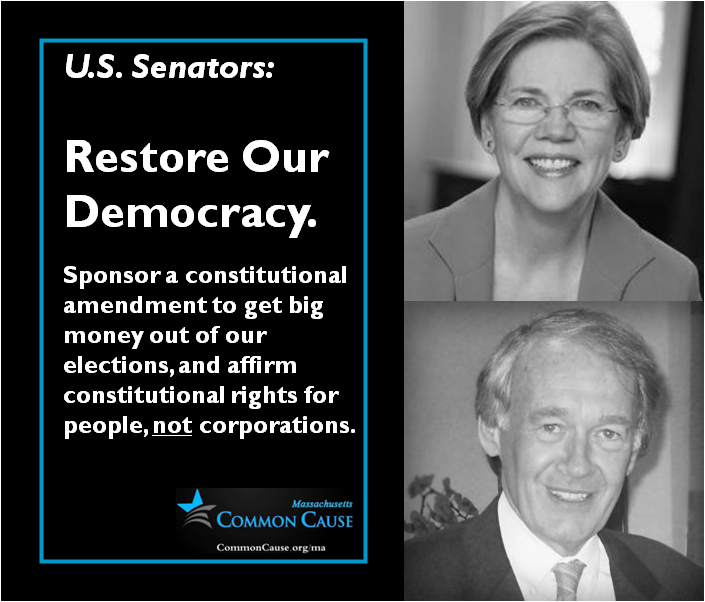
Nine Massachusetts advocacy groups, including three co-convenors of the May Rules Change Summit at UMass Amherst, have penned a letter to the state’s two United States senators asking them to sponsor “sponsor constitutional amendments to get big money out of our elections, and affirm constitution rights for people, not corporations.”
The Democracy Amendment Coalition of Massachusetts (DACMA) is a group of advocacy organizations and activists in Massachusetts working toward an amendment to the U.S. Constitution affirming (1) the power of Congress and the States to limit political contributions and spending, and (2) constitutional rights for natural persons, not corporations.
The groups include Common Cause, BEAT, Free Speech for People, Massvote, Massachusetts Senior Action Council, MassPIRG, Move to Amend, United for a Fair Economy and WILPF Cape Cod.
This was an issue discussed at the Rules Change Summit and is contained in its mission statement (“We support: …
Electoral reforms that restore faith in our democratic process.”)
The coalition’s work has resulted in every House of Representative in Massachusetts sponsoring a democracy amendment in the current Congress. Our efforts now turn to the U.S. Senate where neither Senator has sponsored an amendment. We are circulating an organizational sign on letter urging Senators Markey and Warren to sponsor an amendment. If you represent an organization that would like to be included on the letter please please contact Tyler Creighton at (617) 426-9600 or tcreighton@commoncause.org as soon as possible.
“So one of the things we’re doing in Oregon is we’re developing a genuine progress indicator. This is a metric that quantifies fiscal capital just like GDP, but also quantifies your human capital and your natural capital . . . Even before the onset of the great recession, the economy was not producing the outcomes that we need. Yea, GDP was going up. But so were greenhouse gas emissions, poverty, income equality. The truth is Americans’ ability to achieve upward mobility has been eroding for decades.”
Below is a text, as transcribed by the Rules Change Project, of a 13-minute keynote speech by Oregon “first lady” Cylvia Hayes during June 7, 2014 panel, “All Hands On Deck: Leveraging Business, Civil Society, and Government for System Change.” The panel was part of the CommonBound conference at Northeastern University in Boston, organized by the non-profit New Economics Coalition. The Boston conference program described Hayes as follows: Cylvia Hayes is currently the First Lady of Oregon, where she is spearheading development and implementation of a Genuine Progress Indicator for the state. She is the founder and CEO of 3EStrategies, a clean economy consulting firm; is a Fellow of the American Leadership Forum; and has expertise in collaborative leadership skills.
Thank-you everybody. I love the topic of this panel, because I think it is absolutely essential that all the sectors — business, government, not-for-profit, faith — figure out our niches in this new clean-economy ecosystem. I think there are several roles that government can take. The first is to seize the bully pulpit — raise awareness about critical issues and also paint a powerful vision that points to how things could be.
A second piece is to support the policies and programs that create conditions that make it more likely for positive change to happen. Now, unfortunately, right now our federal government is off the rails. And the gridlock that is being produced by partisan ideologies combined with the fact that too many of our elected officials are more committed to maintaining power than to wielding that power for the greater good has really caused us problems at the federal level.
This is one of the biggest reasons that John decided to run for governor, having been a two-term governor before and knowing what that involved, and why I decided to jump into this truly bizarre position of first lady. And I will tell you I could do a whole other speech on that title, how becoming first lady made me a more radical feminist. But that’s a different topic. (Applause)
Many of our elected officials are more committed to maintaining power than to wielding that power for the greater good . . . [t]his is one of the reasons I decided to jump into this truly bizarre position of first lady. And I will tell you I could do a whole other speech on that title, how becoming first lady made me a more radical feminist.
John and I jumped in because we do believe we are at a point where incrementalism wasn’t going to cut it. We have got to take on systems change in everything from education to energy and we’re not going to get it right now from our federal government. We really think that state and multi-state regional efforts are our best opportunities for powerful innovation and we can prove up new ways of doing things there — we’ll have an opportunity to provide what I call trickle-up leadership.
I have heard it said that if you ask the wrong question, the answers don’t matter. So consider, ever since the onset of the great recession, we have been asking, ‘How can we spur economic recovery?’ But recovery has the sense of going back, of returning to the way things were. And I believe that is the wrong question.
Even before the onset of the great recession, the economy was not producing the outcomes that we need. Yea, GDP was going up. But so were greenhouse gas emissions, poverty, income equality. The truth is Americans’ ability to achieve upward mobility has been eroding for decades. And this generation of young people — our kids and grandkids — are the very first American generation not expected to be better off than their parents were.
We do not need to go back to that. We do not just need economic recovery. We need economic reinvention. (Applause). I think it should raise alarm bells, and I’m sure it does in this room, that the only time we see a downward dip in deforestation or pollution or greenhouse gas emissions is when the economy goes into recession. It’s like economic growth slows, and the planet takes a breath.
After all, as rascally Western novelist Edward Abbey pointed out, growth for the sake of growth is the ideology of the cancer cell. Under what John and I are calling the prosperity agenda, we’re really working on trying to create conditions that will foster growth that betters everybody, growth that makes us muscular, vs. cancerous.
So, in Oregon, John and I are starting a different conversation. We’re asking the question: ‘Does it really make sense to have an economic model that requires continuously escalating consumption of natural resources on a planet of finite natural resources? (Applause) After all, as rascally Western novelist Edward Abbey pointed out, growth for the sake of growth is the ideology of the cancer cell. Under what John and I are calling the prosperity agenda, we’re really working on trying to create conditions that will foster growth that betters everybody, growth that makes us muscular, vs. cancerous. And I’m going to talk about just a couple of the key components of this.
Health-care reform
The first is our health-care reform. Our national debate on this issue has been asking the wrong question. All of the push has been to get additional people insured. And that is important. But we’re failing to ask, insured for what? What should the health-care system look like, and as a result, we’re getting more and more people covered under a health-care system that is rediculously expensive and is producing health incomes that are only marginally better than Cuba’s.
In Oregon, we asked the question: How can we redesign how we deliver health-care services to make people healthier and hopefully save money in the process. We received waivers from the federal government to be able to spend our Medicaid dollars on preventative measures vs. just after-the-illness services. (Applause)
And we have created a whole new sector of workforce — they are community-care workers. And they take a proactive approach to working with people in their homes, in the community, to improve their well being and keep them out of the hospitals — particularly the emergency rooms. It’s early but I can tell you the numbers we have so far, for every dollar we have so far invested in community care workers, we’ve saved between $2.50 and $4.00.
Pacific Coast Collaborative
Another effort that I am super excited about and very personally involved in is the Pacific Coast Collaborative. This is a joint effort of the governors of California, Oregon and Washington and the premier of British Columbia. They have come together to sign an agreement to work collaboratively to accelerate clean-economy development in that West Coast region and aggressively tackle climate change. The approach is to be really bold within each of our jurisdictions because everybody has different laws, different structures, we’ve got to do things a little differently. So do the best we can in each of those four jurisdictions in away that builds a regional economy. And I am pleased to report that a comprehensive outside shows we’ve currently got about 500,000 Pacific Coast residents earning clean-economy paychecks right now — those are full-time jobs — they are paying better, they are growing faster and they have been more recession resistant than the conventional economy. (Applause) I just say when you put California, Oregon, Washington and British Columbia together we’re the fifth-largest economy in the world . . . if we added some of your states, maybe we’d get to fourth [largest].
Measuring genuine progress, not just GDP
Another piece of the prosperity agenda that was mentioned earlier is our shift to measuring what matters. One of the really brilliant things, insights, in my opinion that John had, he was two-term governor for eight years, was out of office for eight years, and during that time he realized, you can’t effectively govern a state in a two-year, biennial budget cycle. For instance, you cannot see the return on investment for things like early-learning programs, or programs that support low-income, at-risk families. But when you go out 5-7 years, that’s an ROI of many, many dollars to one. So he moved forward with implementation of a 10-year state plan and a 10-year state budget, so we could actually start seeing some of the implications of our policy decisions on our fiscal resources.
I have been part of the movement to move beyond gross-domestic product as a way of measuring success for almost 20 years. (Applause) And we have momentum, like I have never seen, people. This is very exciting. So one of the things we’re doing in Oregon is we’re developing a genuine progress indicator.
Meanwhile and prior, I have been part of the movement to move beyond gross-domestic product as a way of measuring success for almost 20 years. (Applause) And we have momentum, like I have never seen, people. This is very exciting. So one of the things we’re doing in Oregon is we’re developing a genuine progress indicator. This is a metric that quantifies fiscal capital just like GDP, but also quantifies your human capital and your natural capital. And we’re integrating that into our 10-year plan and we intend to use it as a filter in developing our next state budget. (Applause) I’m super excited about that one. And there are a number of states that are doing this and if you want to, this is a shameless plug, but if want to know more about that you should come to the Beyond GDP workshop tomorrow where we’ll be talking about that.
A focus on reducing poverty
The final thing I want to talk about is our direct focus, in Oregon, on poverty. And talking about the poverty crisis in your state is not something that most high-level political analysts will advise a high-level politician to do. But Martin Luther King said, if you don’t talk about race, you are going to have racism. And I think the same holds true on poverty. So the governor and I are talking about it and we’re talking about it a lot and we’re talking about it not just as a human tragedy but as a tremendous economic drain. We’re also talking about the fact that this is not just about lazy people who need to work harder. The reason we have a poverty crisis is in part because we have an economic system that is institutionalizing economic classism. (Applause) I am thrilled to report and I can’t tell you how helpful this has been. We have been effective enough in making the economic argument on this that Oregon’s largest business association has gotten on board and they have recently added poverty reduction as one of the top three goals of the Oregon Business Plan. We have really significant partnership there now.
We’re also talking about the fact that this is not just about lazy people who need to work harder. The reason we have a poverty crisis is in part because we have an economic system that is institutionalizing economic classism. (Applause)
And this is personal, this one is personal. For me. I have experienced a taste of the destructive force of poverty. I am the first of my ancestry to be born outside of Oklahoma and Arkansas. That happened because my mom left her first husband for his younger brother, and they had to get the hell out of Dodge. So my older half-brother and sister are my half brother and sister and my cousins. That’s probably not something you expected to hear today. That is why I was born in the Pacific Northwest, for which I am so grateful — you can’t even imagine. My parents were hard-working but under-educated. We lived up in a shack in the foothills in Washington state and lived without power or electricity for awhile. Over time, mental illness and alcoholism took their toll on my parents and I wound up on my own at age 16 and I have struggled financially for most of my life. I know exactly what it is like to have to choose between paying the rent or the electricity. I know what it is like to put off going to the doctor because you’ve gotta’ have that last bit of gas money to get back and forth to work in between paychecks.
I also know that if I hadn’t had help, both from caring individuals and from effective systems, I would not have been able to go on to become a first-generation college graduate and be living the life I’m living today. (Applause) I’m grateful for that, and I’m pissed off that our systems have eroded to point where it is harder today to do that than it was when I did it. (Applause)
So these are just some of the highlights that we’re working on in Oregon trying to get to a more healthy economic model. I know that all of you are working hard in your niches trying to get to that same place and it sometimes feels like a heavy, heavy lift. And for me when I get to feeling like that one small person trying to change the whole global capitalist structure, it’s helpful for me to remember that the economy is not the Atlantic Ocean. It is not the Grand Canyon. It is not a force of nature or an act of God. It is something that humans have made over generations. We invented it. Which means we absolutely can re-invent it. (Applause)
And you all are doing that. There are so many examples of the new economy being put into action. This is absolutely the time to lean into making this a true movement. Because we are right, we are necessary and we are powerful. Thank-you. (Applause)
Bill Baue (CONTACT) and Robin Wood (CONTACT) are on a mission to change the discussion about the future of humanity and our planet, and about how our economies function. The idea of “sustainability,” they say, is inadequate, because it implies little more than survivability – a dour retreat from disaster.
But to inspire people to change behavior – bringing corporations along with them – the duo believes a new word is essential – “thrivability” – not merely surviving, flourishing, prospering, blossoming.
“Sustainability is framed in constraints and limitations that suppress enthusiasm,” says Baue. “It’s a terminally uninspiring world that closes you down instead of firing you up. Positive framing around how we can collectively thrive, on the other hand, is inspiring and motivational, tapping into the human drive for satisfaction and fulfillment. What’s going to inspire people to support change in a compelling way rather than a shrinking way.”
Proponents of “thriveability” see it as including a component of social justice. In a phrase used by many thrivability researchers: “Real thrivability means no one gets left behind in poverty, exposed unfairly to disaster, or suffers at the hand of corrupt governments.”
Baue, who lives in an Amherst, Mass. cohousing community, calls himself a corporate sustainability architect. He co-founded the Sustainability Context Group, a global community of thought leaders and practitioners who advocate for “context-based sustainability”, and Sea Change Radio, a globally syndicated podcast on sustainability. He works with major brands, and teaches in the Sustainability MBA program at Marlboro College in Brattleboro, Vt.
Wood is founder of the ThriveAbility Foundation. He also operates a corporate retreat center along the southern Mediterranean coast of France. He is an entrepreneur and futurist author of books with titles like “The Trouble with Paradise,” and “The Great Shift – Catalyzing the Second Renaissance.” He also holds a doctor from the London Business School.
They each are advancing the work of the UK-based ThriveAbility Foundation. In addition to measuring impacts in the present and calculating what it might take to stop the degradation and collapse of world ecosystems, the foundation’s approach is aspirational – where the quantitative elements that would characterize flourishing prospering, blossoming cultures in, say, 50 years. Then, from that vision, it asks, “How do we look back on what needs to happen to get there?”
The foundation’s approach is to take existing sustainability data from the Global Reporting Initiative and Sustainability Accounting Standards Board, and compare them to the metrics for thriving 50 years out – and then work on closing the gap. The idea is to shift from a focus on limits to a focus on possibilities.
“ThriveAbility adds a focus on social and cultural leadership – human and interpersonal dynamics,” says Baue. “The search for sustainability has largely been a technocratic exercise instead of looking at something like, ‘Where do we need to make mind shift changes to achieve that?’ ”
Baue says movement toward a thriving world is hampered by at least three things:
There is a big difference currently between the commitments that organizations need to make to ensure long-term viability of their businesses and the commitments they have made to most sustainability programs. He says this has been called the “sustainability gap.”
Many key indicators of sustainability used in the corporate world are proprietary, and only a small number of people have access to the data. The ThriveAbility Foundation wants to create an index that is treated as an open and global “public good” serving all humanity, not private stakeholders.
The meaning “thriving” is not yet uniform. People are seen as thriving when they earn large salaries even though research shows that generally unrelated to happiness. Thriving might also be living within your bounds instead of overstepping them, Baue says.
Measuring thriveability in the corporate context
Baue continues:
“A few years ago, I attended a stakeholder engagement with a prominent global automobile brand. Much of the conversation focused on technocratic solutions, such as reducing the carbon footprint of its manufacturing and of its vehicles. As well, there were breakthrough innovations around building out electric vehicles as its new generation of fleets, which stands to radically reduce emissions associated with its products. All of this is positive momentum.
“That said, the really interesting aspects of the conversation focused on a much more profound breakthrough — namely, in the mental mindset of how the company perceives itself and its business model for creating positive value in the world and for its shareholders. The shift there was from conceiving of itself primarily as an automobile manufacturer — i.e. delivering specific mechanisms (automobiles) for achieving a purpose (transportation) — to conceiving of itself as a company that delivers sustainable mobility. In other words, leapfrogging to focus on the ultimate ends, not just the means. This shift would move the company away from achieving financial growth via more “throughput” — or, in other words, producing more automobiles, which have negative impacts associated with them no matter how efficient they’re made or run.
“Thus, a company seeking to achieve ThriveAbility for all its stakeholders refocuses its business model on creating net positive (or even gross positive) impacts across its entire value chain. In this example, a sustainable mobility company is less focused on increasing the mechanisms of transportation, and more interested in providing sustainable mobility solutions, such as transportation sharing, smart logistics, etc. This is the kind of company that will leapfrog from minimizing its negative impacts to maximizing its positive impacts.
“As important as it is to fill the sustainability gap with technocratic solutions, achieving true ThriveAbility requires more profound transformations that tap into our innate human potential. ThriveAbility focuses on developing the leadership necessary to create the kinds of breakthrough innovations that will shift our economy from net negative to net positive social and environmental impacts.
“These solutions will come not from tinkering with business models adapted from 20th Century thinking, but rather are emerging from new business models that regenerate natural, social and human capitals.
“For example, business models that do not need to reverse engineer carbon out of their processes, but rather that sequester more carbon than they generate, creating “gross positive” impacts on society and the planet. Examples would be agricultural products that absorb carbon while growing, then store it during the useful life of the product and then bury it as soil enhancement at the end of its productive life.”
Wood adds:
“As important as it is to fill the sustainability gap with technocratic solutions, achieving true ThriveAbility requires more profound transformations that tap into our innate human potential. ThriveAbility focuses on developing the leadership necessary to create the kinds of breakthrough innovations that will shift our economy from net negative to net positive social and environmental impacts.
“These solutions will come not from tinkering with business models adapted from 20th Century thinking, but rather are emerging from new business models that regenerate natural, social and human capitals.”
Newspapers across American who take The Associated Press are carrying an AP story based on census data and interviews with poverty-research experts by the ubiquitous wire service. “Four out of 5 U.S. adults struggle with joblessness, near-poverty or reliance on welfare for at least parts of their lives,” says the story’s lead. Mark R. Rank, a sociology professor at Washington University in St. Louis, did number-crunching for The AP that produced the story’s findings. Rank’s data compilations show, for example, more than 19 million whites now fall below the poverty line of $23,021 for a family of four.
Pundit Tom Blumer on the “liberal-media” bashing blog site NewsBusters essentially replies: “So what,” everyone faces adversity at some point in their lives. Then the libertarian blog “The Rio Norte Line” juxtaposes text of President Obama’s speech in Galesburg, Ill., over the weekend with the AP’s reporting and implies a disconnect between Obama’s expressions of faith that the economy is recovering and the reality portrayed in the AP story published Sunday, July 28 and written by AP staffer Hope Yen. Excerpting from her story:
Washington University’s Mark Rank
“Poverty is no longer an issue of ‘them’, it’s an issue of ‘us’,” says Mark Rank, a professor at Washington University in St. Louis who calculated the numbers. “Only when poverty is thought of as a mainstream event, rather than a fringe experience that just affects blacks and Hispanics, can we really begin to build broader support for programs that lift people in need.”The numbers come from Rank’s analysis being published by the Oxford University Press. They are supplemented with interviews and figures provided to the AP by Tom Hirschl, a professor at Cornell University; John Iceland, a sociology professor at Penn State University; the University of New Hampshire’s Carsey Institute; the Census Bureau; and the Population Reference Bureau.
So the news-literacy challenge here is figuring out to what degree The AP’s findings represent a fundamental shift in American’s perceptions or reality, and how important an impact that has on our ability to sustain participatory democracy. But what’s remarkable is that this debate is breaking out in the main stream media — a debate about, in effect, what has happened to the American Dream.
In a post on his blog, Economist Gar Alperovitz describes his surprise at the growing amount of mainstream interest in changing how capitalism works. He describes it in the context of an invitation to speak in Orlando, Fla., on Aug. 11, 2013 to the Academy of Management which has made “Capitalism in Question” the theme of its annual conference. The AOM is a professional association for scholars of management and organizations that was established in 1936. You can also listen to Alperovitz in a talk (recorded by New Hampshire Public Radio) at the Monadnock Lyceum: “Is There an America Beyond Capitalism?”
The program overview for the AOM’s annual meeting reads:
The Academy of Management’s vision statement says that we aim “to inspire and enable a better world through our scholarship and teaching about management and organizations.” The recent economic and financial crises, austerity, and unemployment, and the emergence of many economic, social, and environmental protest movements around the world have put back on the agenda some big questions about this vision: What kind of economic system would this better world be built on? Would it be a capitalist one? If so, what kind of capitalism? If not, what are the alternatives? Although most of our work does not usually ask such “big” questions, the assumptions we make about the corresponding answers deeply influence our research, teaching, and service.
Shift Change: Putting Democracy to Work (2012)is an entertaining look inside the burgeoning co-operative movement. In this documentary, Mark Dworkin and Melissa Young portray the growing world of employee-owned firms.
Shift Change seeks to find more egalitarian solutions to the economic problems that have accompanied structural changes like the disappearance of the manufacturing sector. The film shows employee-owned firms of various sizes and from multiple countries. A large portion highlights the Mondragon Corporation, a giant in the co-operative business world — headquartered in the Basque region of Spain. Mondragon is cited as a great success story for aspiring worker co-operatives. They have thrived while adhering to their core values of cooperation, participation, social responsibility and innovation. The firm is organized into the areas of finance, industry, distribution and knowledge. Today Mondragon is the largest Basque business group and the 10th largest in Spain. According to the film’s website:
There is growing interest in firms that are owned and managed by their workers. Such firms tend to be more profitable and innovative, and more committed to the communities where they are based. Yet the public has little knowledge of their success, and the promise they offer for a better life.
The city of Chicago took a unique route in combating crime: by giving jobs to students in high-crime, low-income neighborhoods. The result: 43% fewer violent-crime arrests.
Data map shows crime distribution in Chicago
A study on the program directed by The University of Chicago Crime Lab produced optimistic results. The study contained 1,634 teens across 13 different schools, providing them with minimum wage jobs working 25 hours a week. The jobs included camp counselors, office assistants, and working in community gardens. The second part of the program included assigning mentors to these students, and 10 hours a week spent learning to manage pent up emotion that would be inhibiting in trying to acquire secure employment.
Students who were randomly selected for the program had 43 percent fewer violent-crime arrests relative to students in a control group. These results are important because they show how unique policy solutions are possible and can promote meaningful change. Although the program only lasted 16 months, a decline in violent crime was seen even 14 months after the program had concluded.
The study suggests that equality of opportunity is a vital component of an individual’s healthy participation in society — and that it’s important that people from all socio-economic backgrounds have access to work in order to improve the quality of their lives.
ASSESSMENT: The success of the program in Chicago shows that long-term progress can be achieved by not only providing people with income opportunities, but by putting them in constructive environments where character is built. Fortunately, programs of this sort are relatively inexpensive and represent unique policy solutions.
In November, 2012, an anonymous videographer with the YouTube account name “politizane,” posted a remarkable six-minute video visualizing with charts a set of data about income and inequality in America. Here’s the link: http://www.youtube.com/watch?v=QPKKQnijnsM.
In March, 2013, another anonymous YouTube account, “Learn Liberty” posted a response, using video featuring Brandon Turner, a visiting assistant professor at American University. Link: http://www.youtube.com/watch?v=44LHBViTZI0. It also features Steven Horwitz, a St. Lawrence University economics professor. It had garnered 123,000 views as of November, 2013.
The “Wealth In America” videographer apparently remains anonymous, although this post indicates he lives in Texas, and credits most of the underlying data analysis to Mother Jones magazine.